Volcano morphology & eruption classification

Class 8 - Making sense of this mess

Sébastien Biass

Group of physical volcanology and geological risk - 1st floor, office 103

April 13, 2026

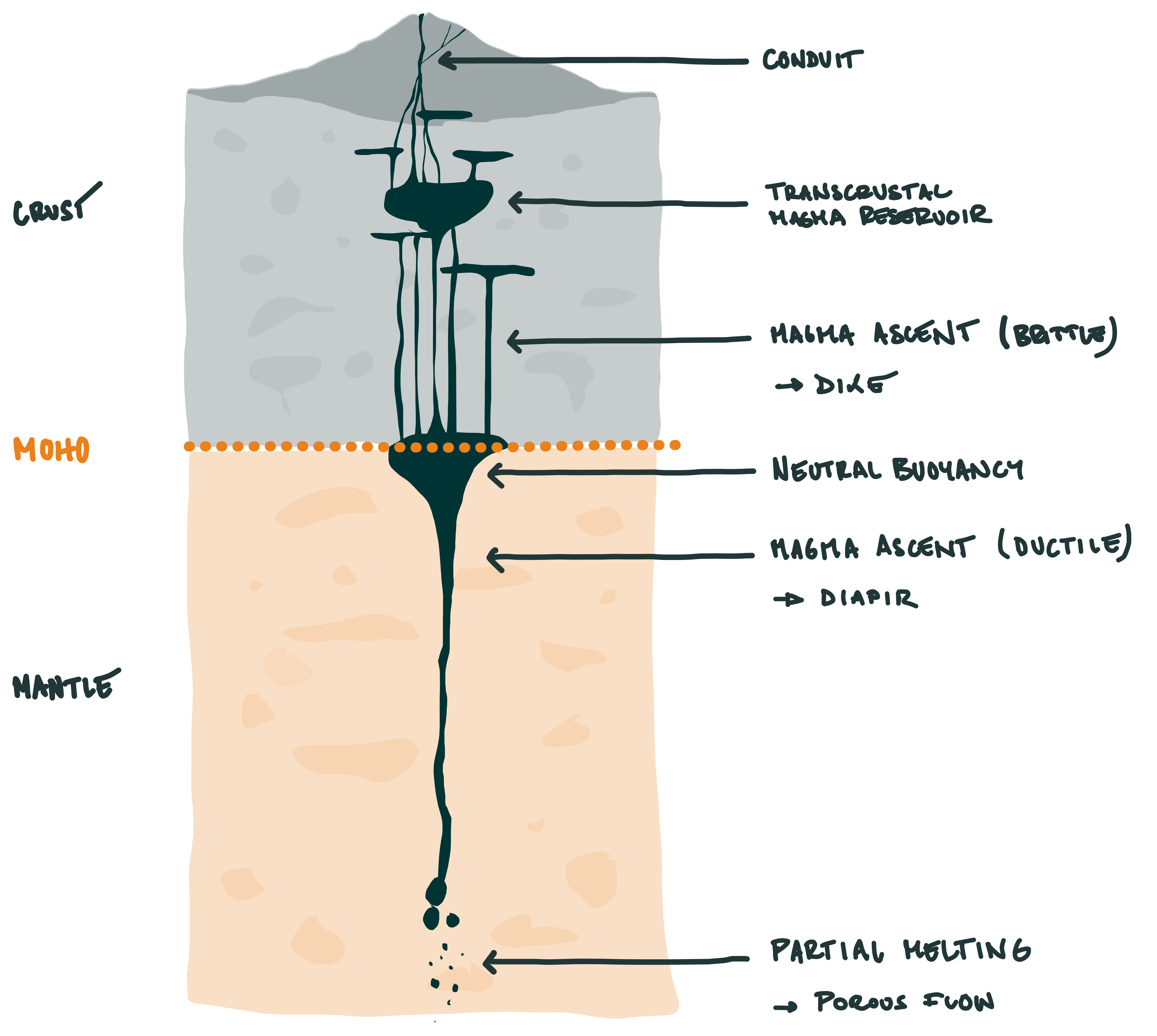
From depth → surface

  • Surface expression is the result of a long journey
  • Diversity of eruptive styles, products, morphologies etc…
Today’s objectives


To be useful, a classification must be as simple as possible; above all, it must be useable in the field. - C. F. Park, Jr 1964


The purpose of classification is not to set forth final and indisputable truths, but rather to afford stepping stones towards better understanding – LC Graton (1880-1970)


How can we classify

  • Volcanoes?
  • Eruptions?

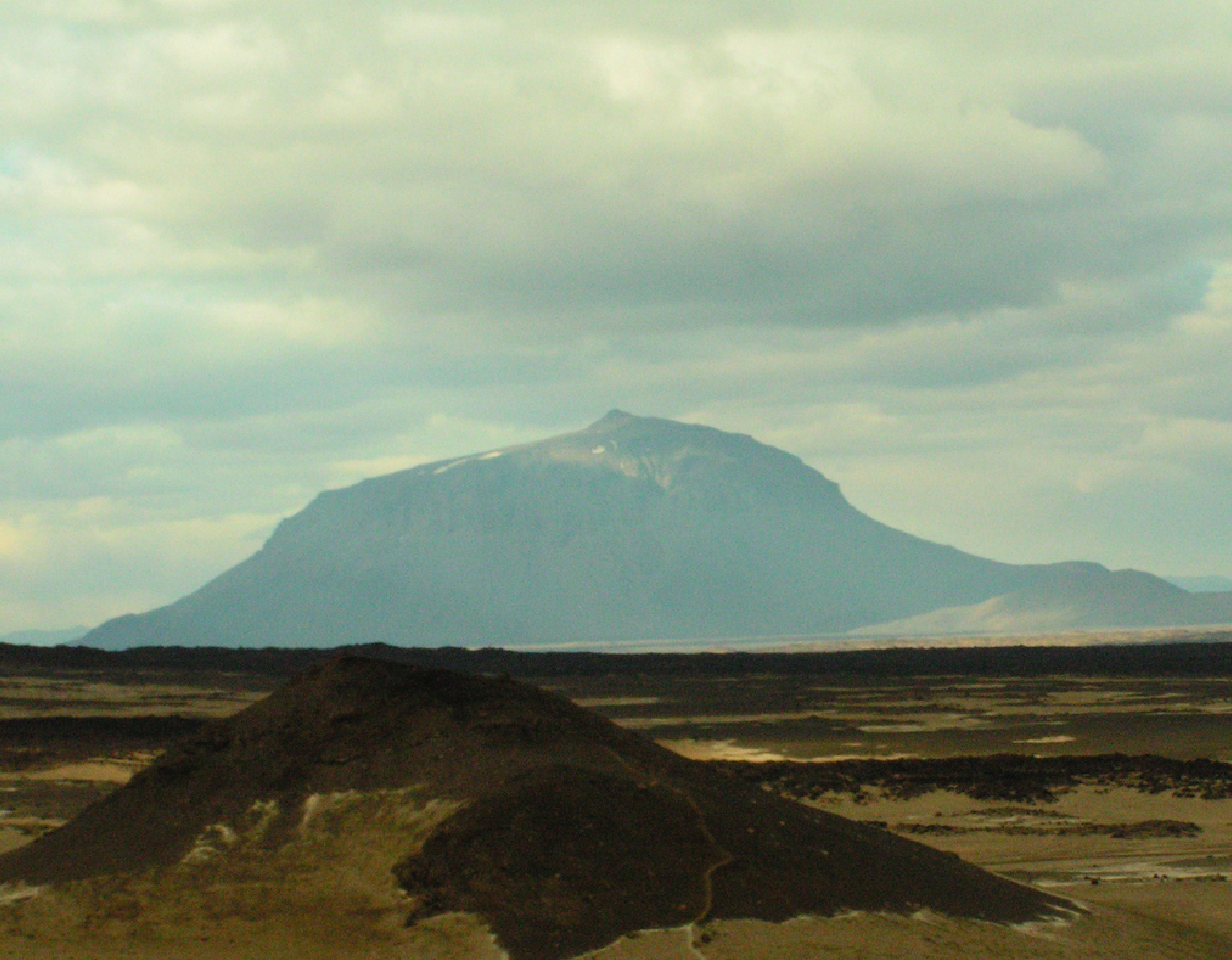
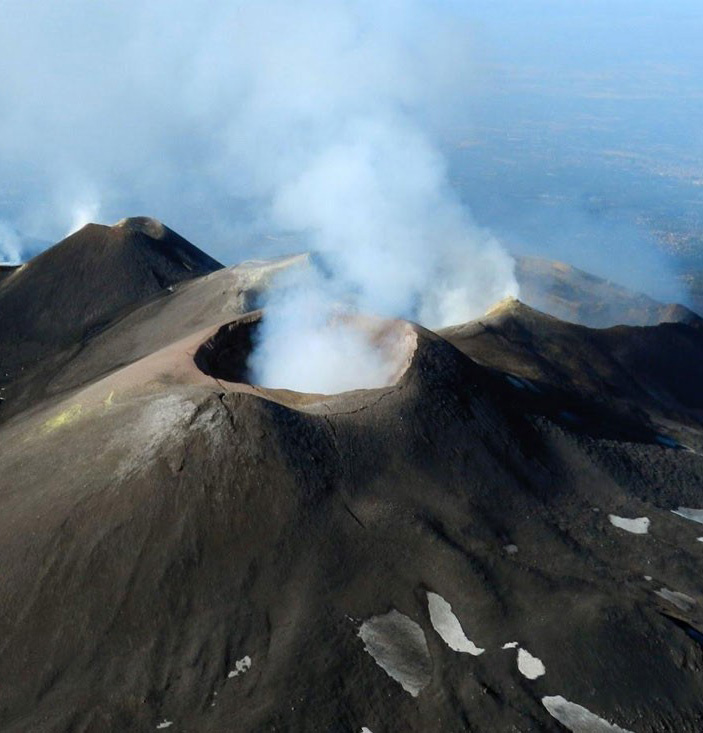
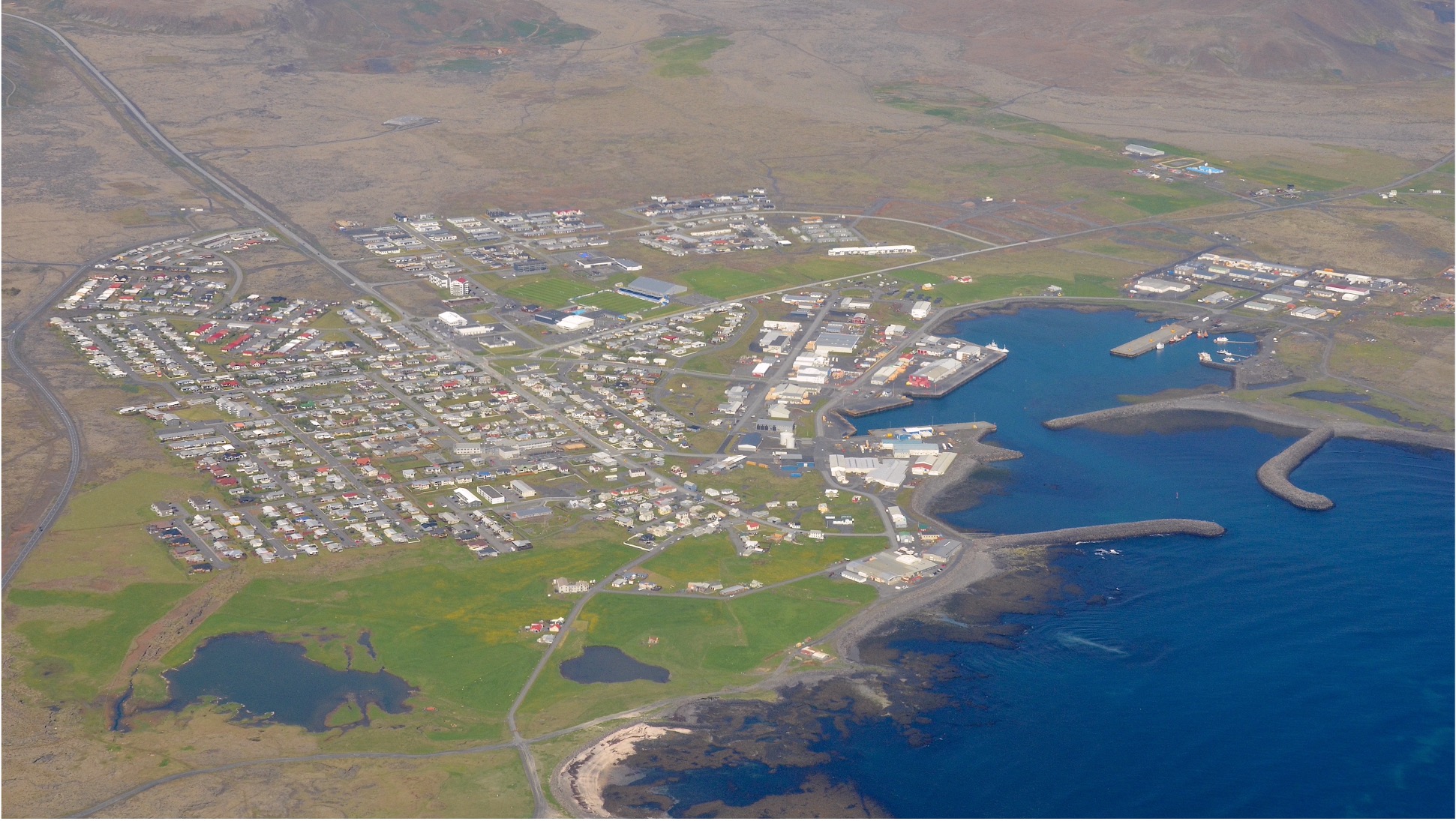
Svartsengi

Pu‘u ’Ō‘ō

Morphology of volcanic landforms

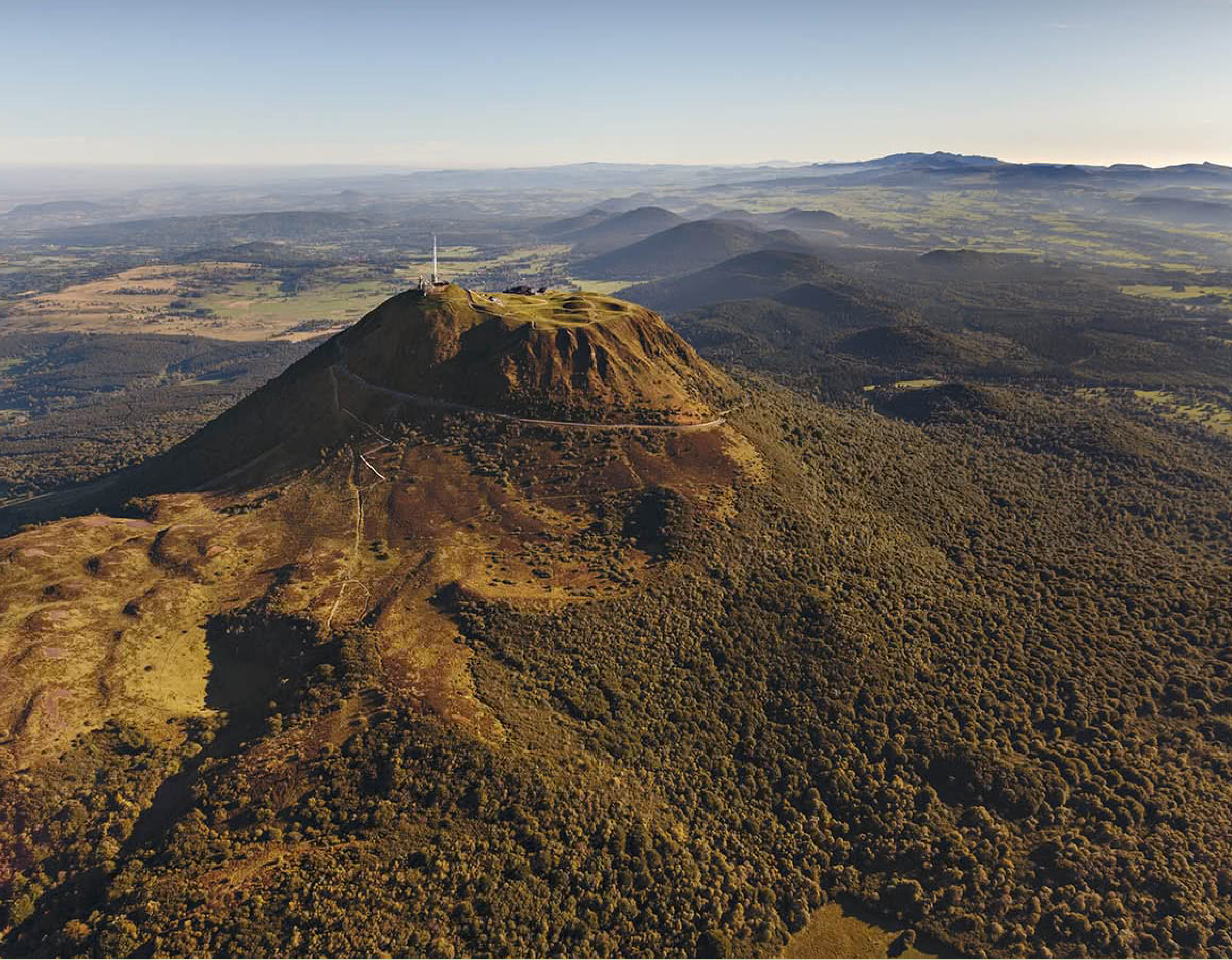
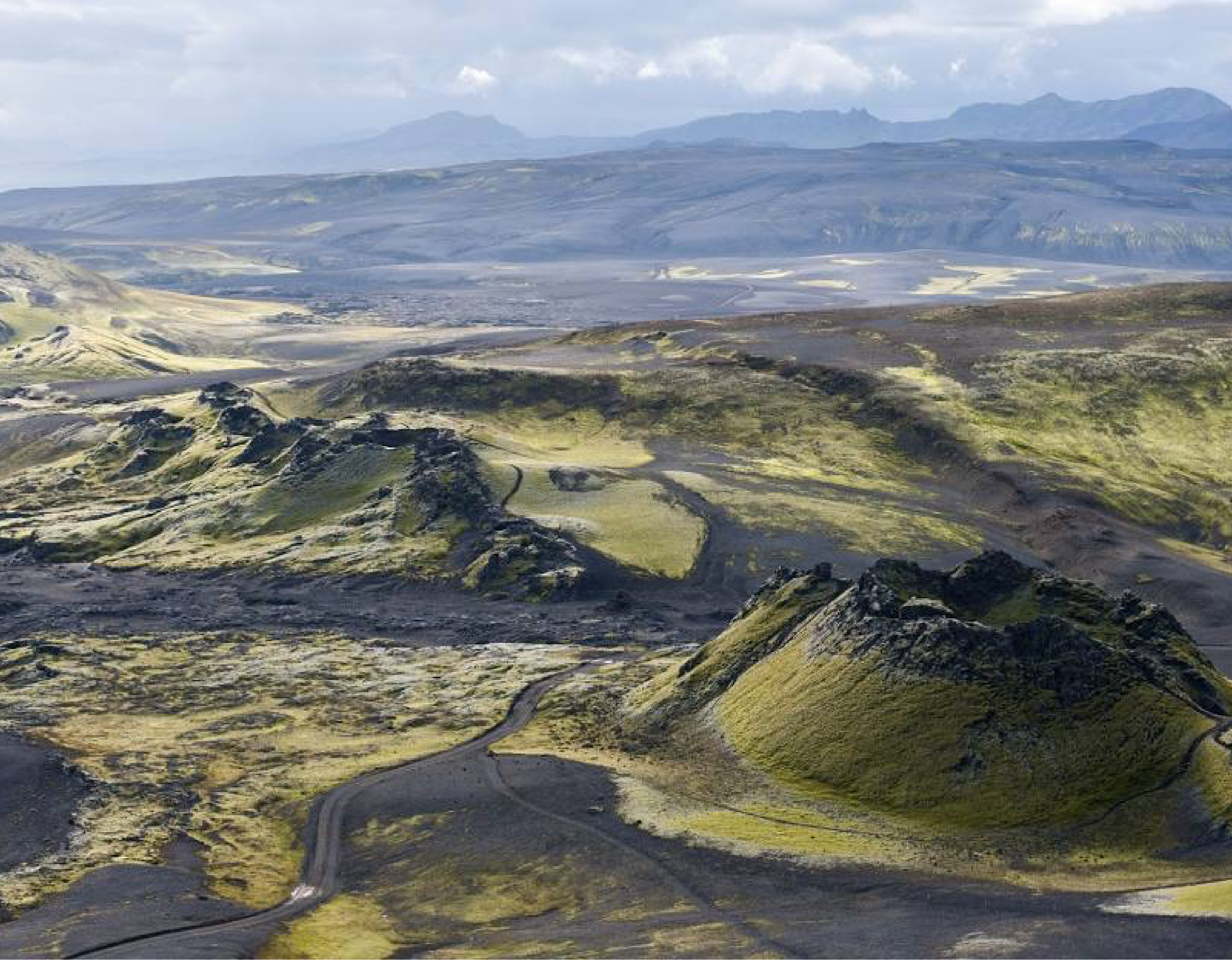
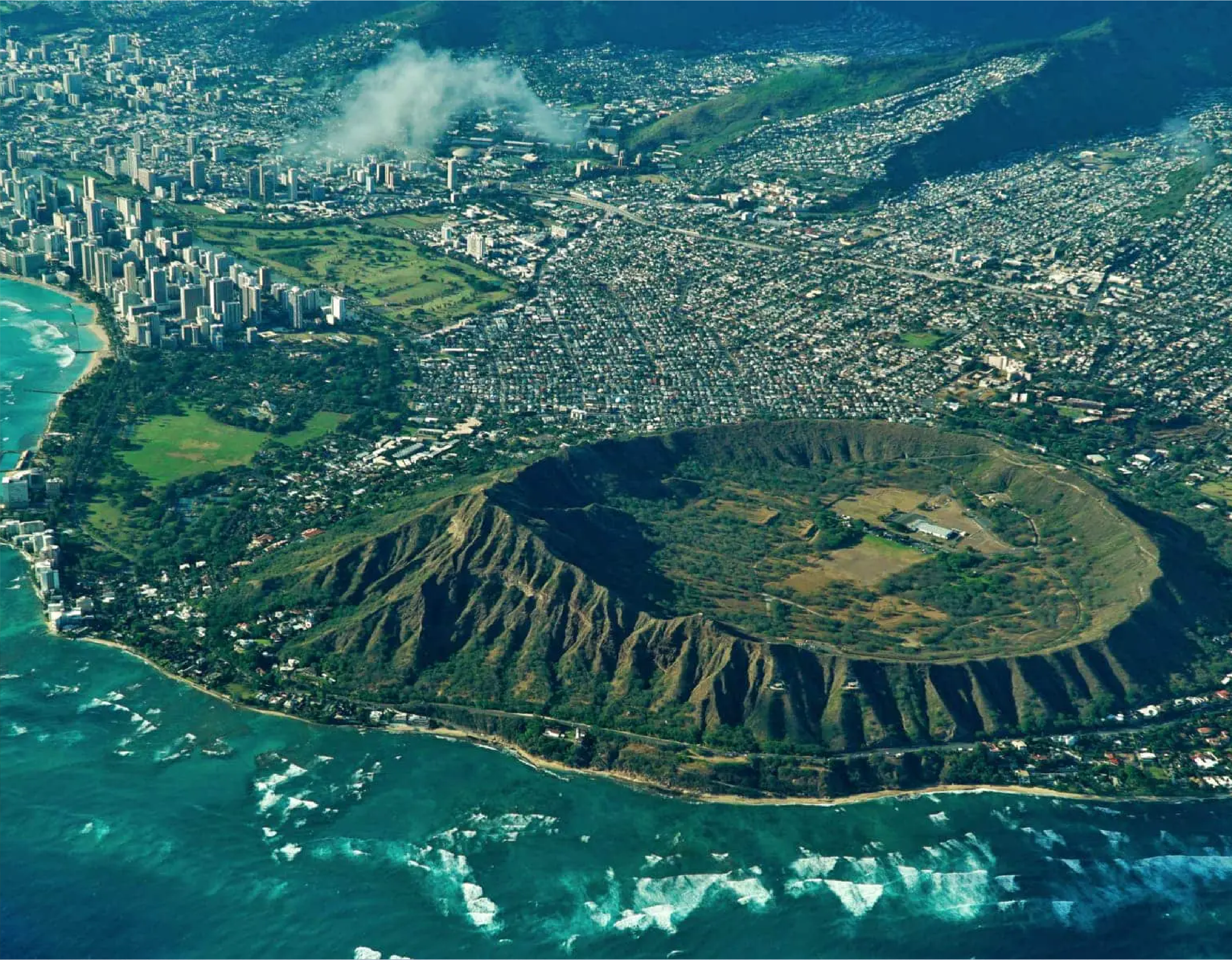
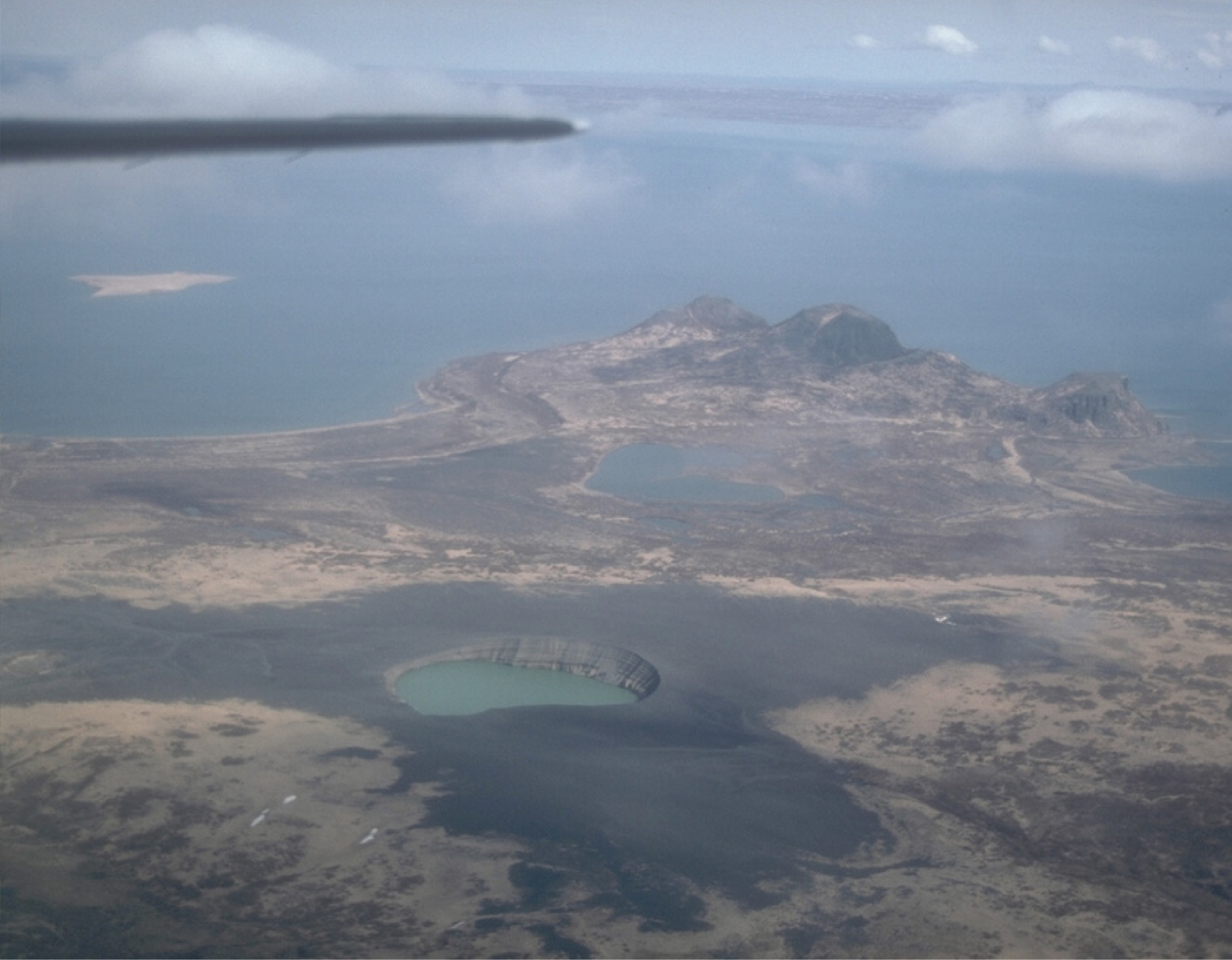
Common volcanic landforms

Why do volcanic landforms look so different?

→ Try connecting shape to physical processes

Some we have seen:

  • Lava type
  • Temperature
  • Gas

Others from intuition:

  • Context
  • Influence of water?
    • Which source?
  • Monogenetic vs polygenetic?

Volcanic landforms

What does morphology tell us?

  • Morphology = time-integrated signal of all eruption styles during the volcano’s history
  • Directly linked to physical processes
  • Several morphologies can constitute a single volcano
  • Difference between
    • monogenetic → one vent per eruption and
    • polygenetic → eruptions from ± central crater
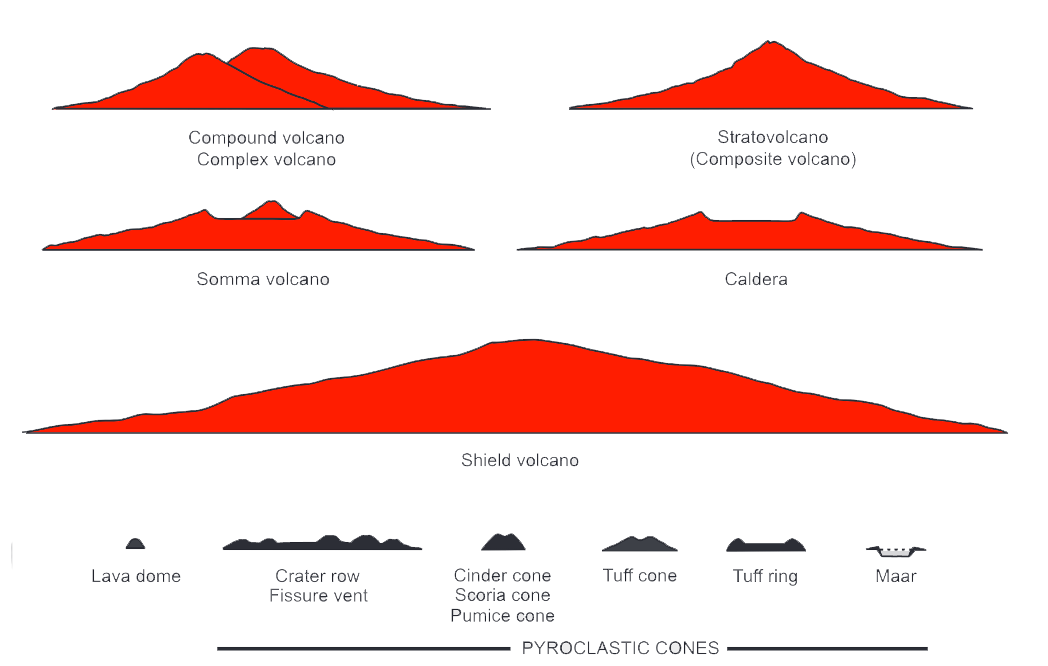
Types of volcanoes. Schematic profiles are vertically exaggerated by 2:1 (colored fill) and 4:1 (black fill). Simkin et al. (2010)

Types of volcanoes. Schematic profiles are vertically exaggerated by 2:1 (colored fill) and 4:1 (black fill). Simkin et al. (2010)

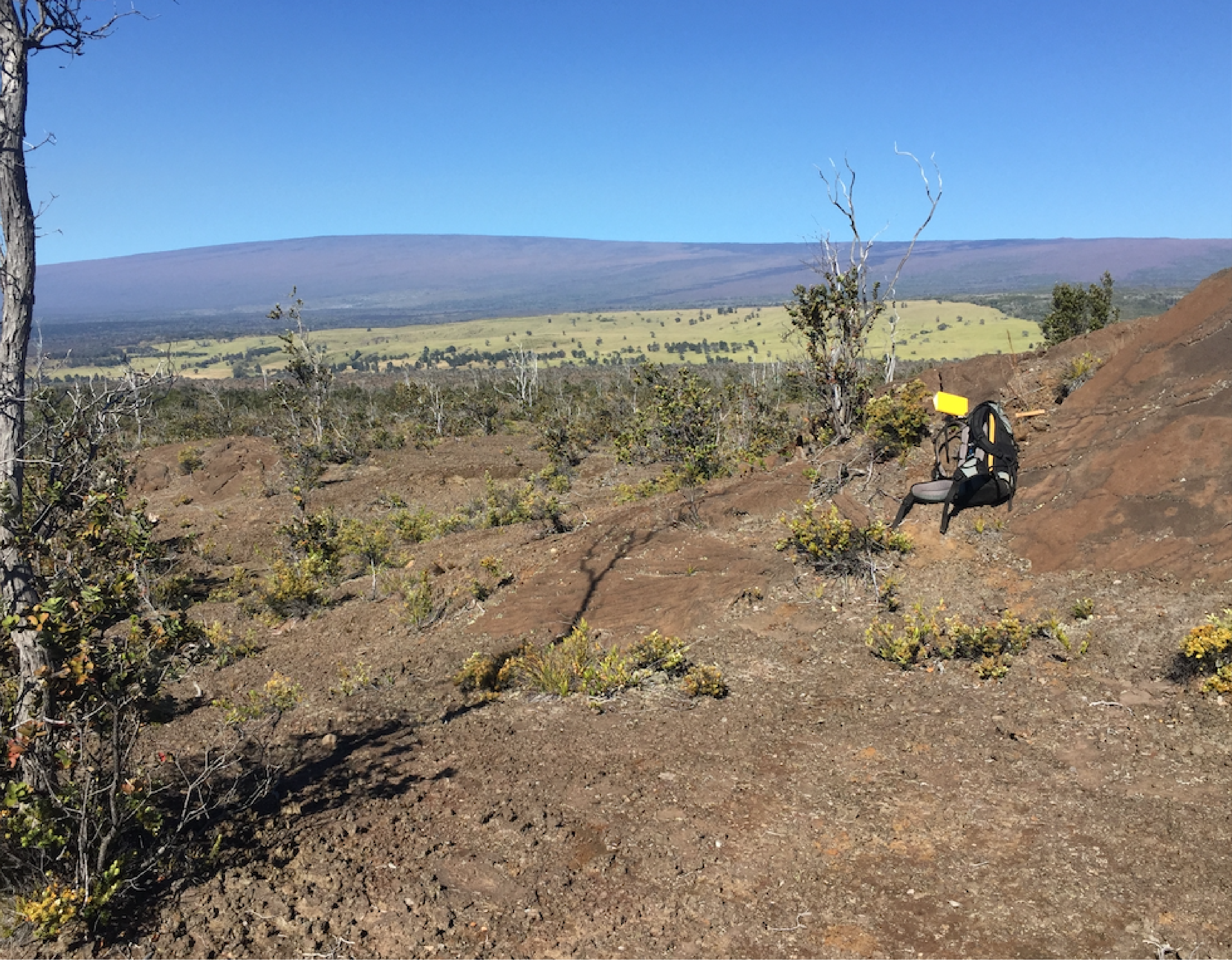
Shield volcanoes

Properties

  • Polygenetic
  • Broad, low slopes
  • Large footprint
  • Mostly built by lava flows

Processes

  • Lava flow properties?
  • Lava flow length?
  • Degassing efficiency?

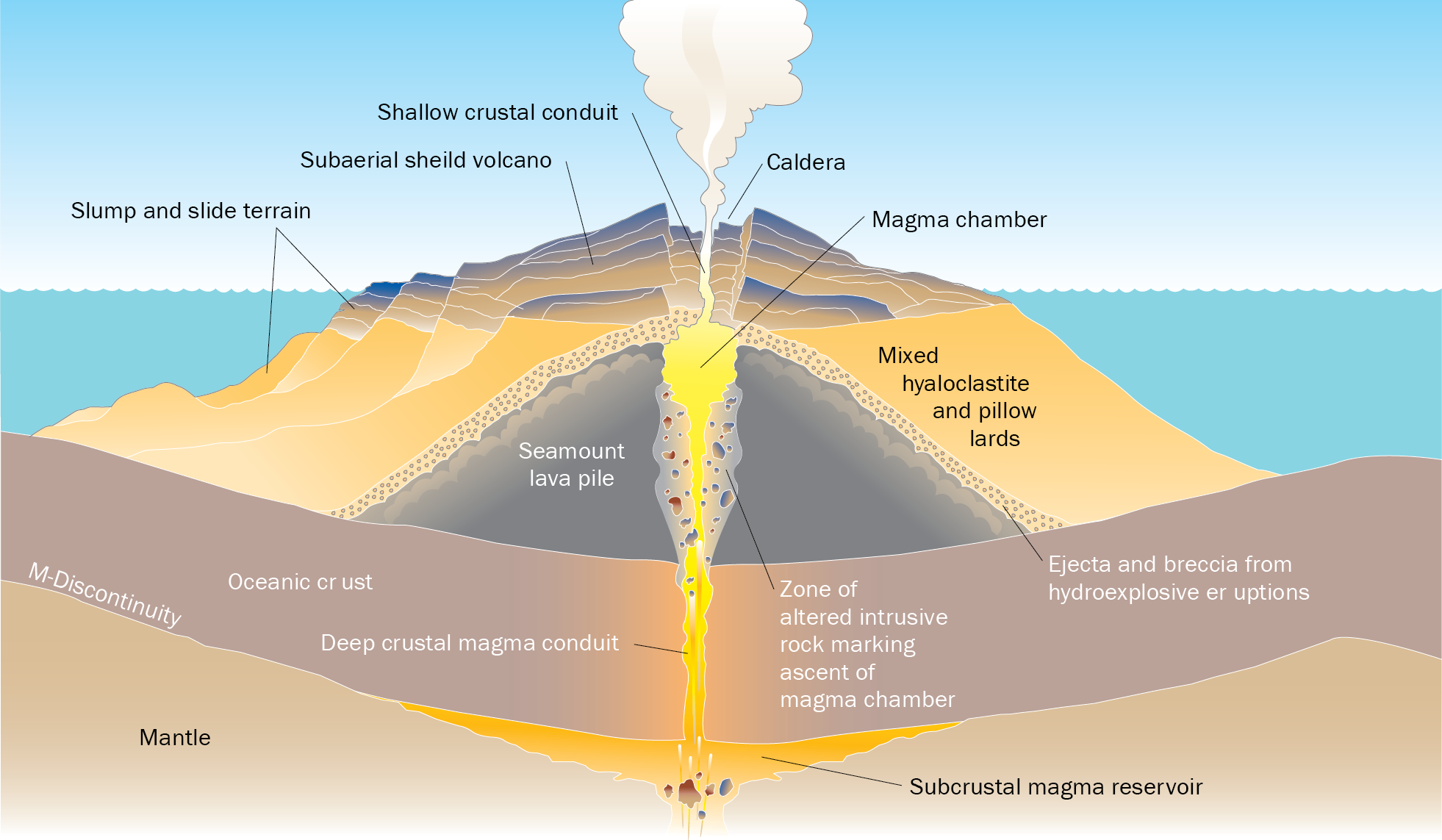
Schematic cross section of a typical Hawaiian shield volcano. Lockwood et al. (2022)

Schematic cross section of a typical Hawaiian shield volcano. Lockwood et al. (2022)

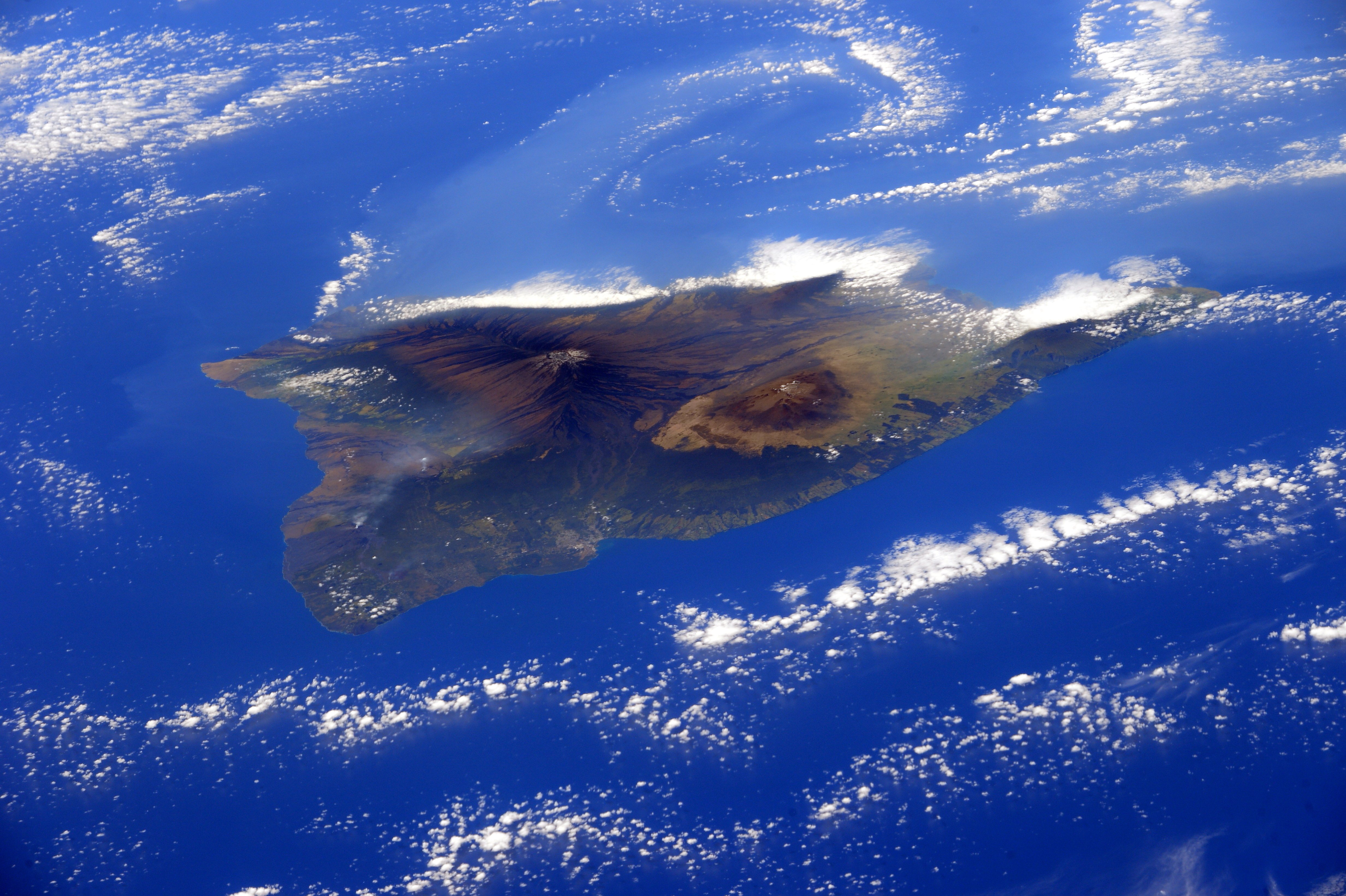
The Big Island of Hawaii from ISS (credit NASA)

The Big Island of Hawaii from ISS (credit NASA)

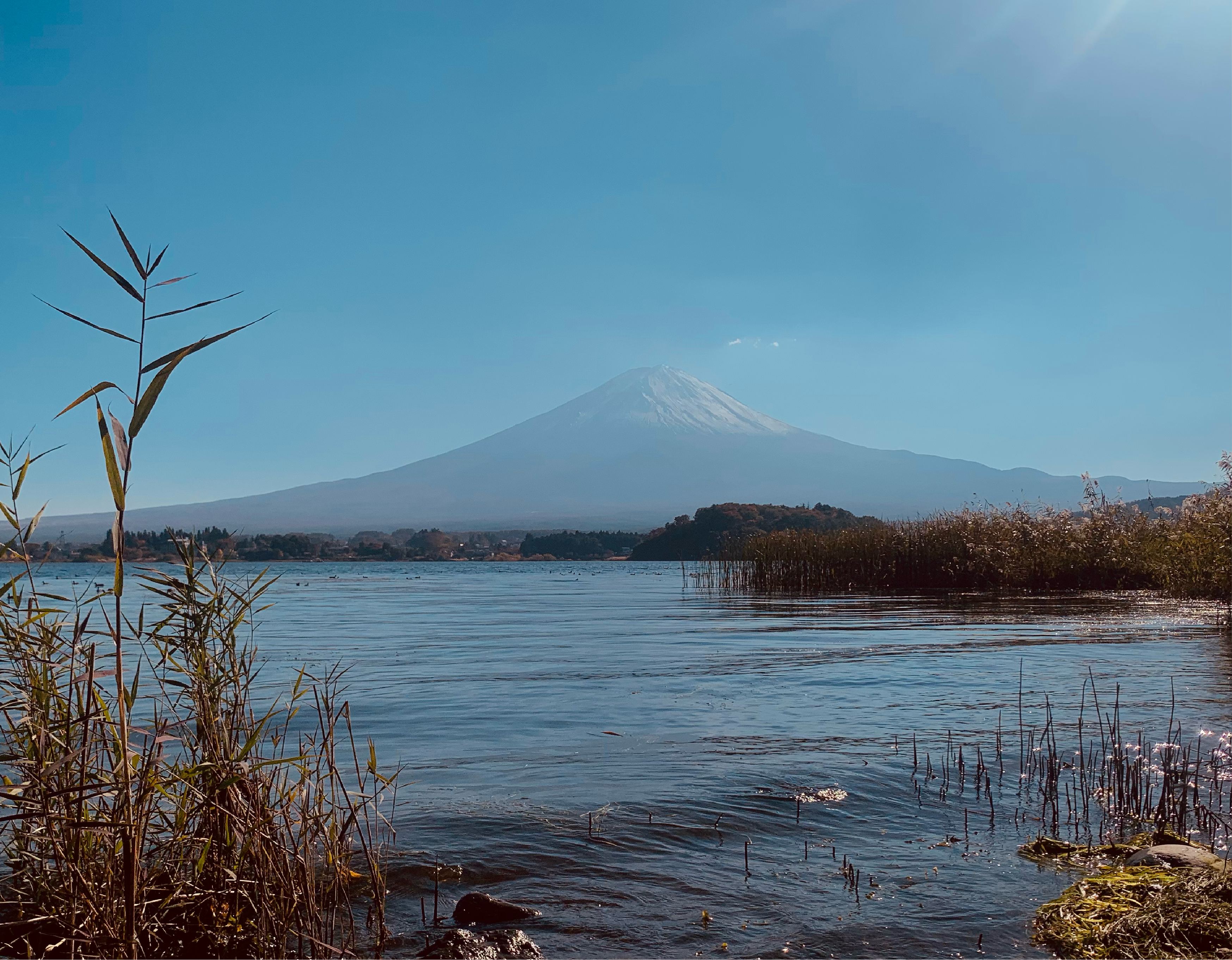
Strato/composite volcanoes

Properties

  • Polygenetic
  • Conical shape
  • Large footprint
  • Mostly built by lava flows
  • Often composite → multiple morphologies

Processes

  • Lava flow properties?
  • Lava flow length?
  • Degassing efficiency?

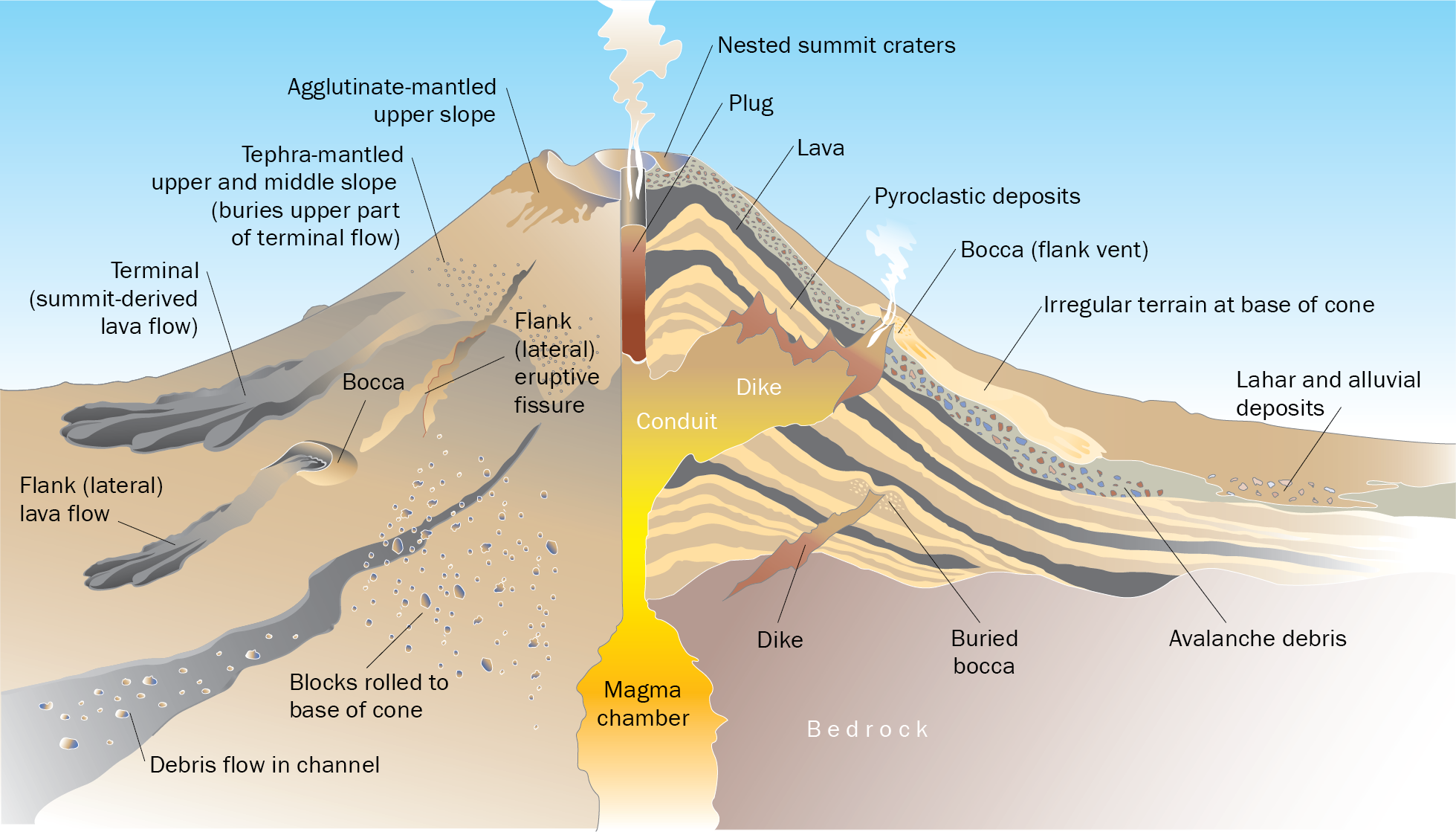
Anatomy of a strato/composite volcano. Lockwood et al. (2022)

Anatomy of a strato/composite volcano. Lockwood et al. (2022)

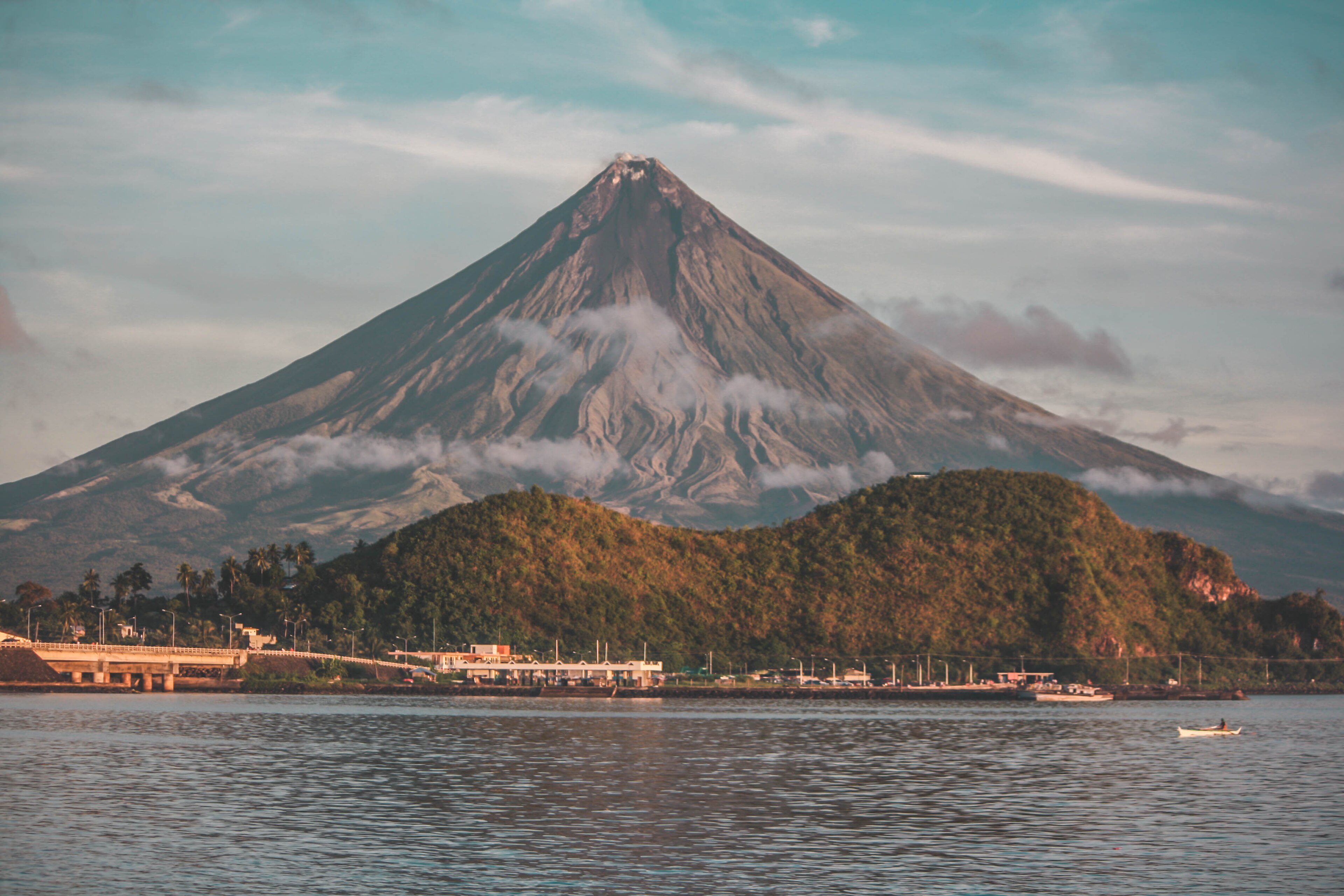
Mayon volcano in the Philippines (credit Wikipedia).

Mayon volcano in the Philippines (credit Wikipedia).

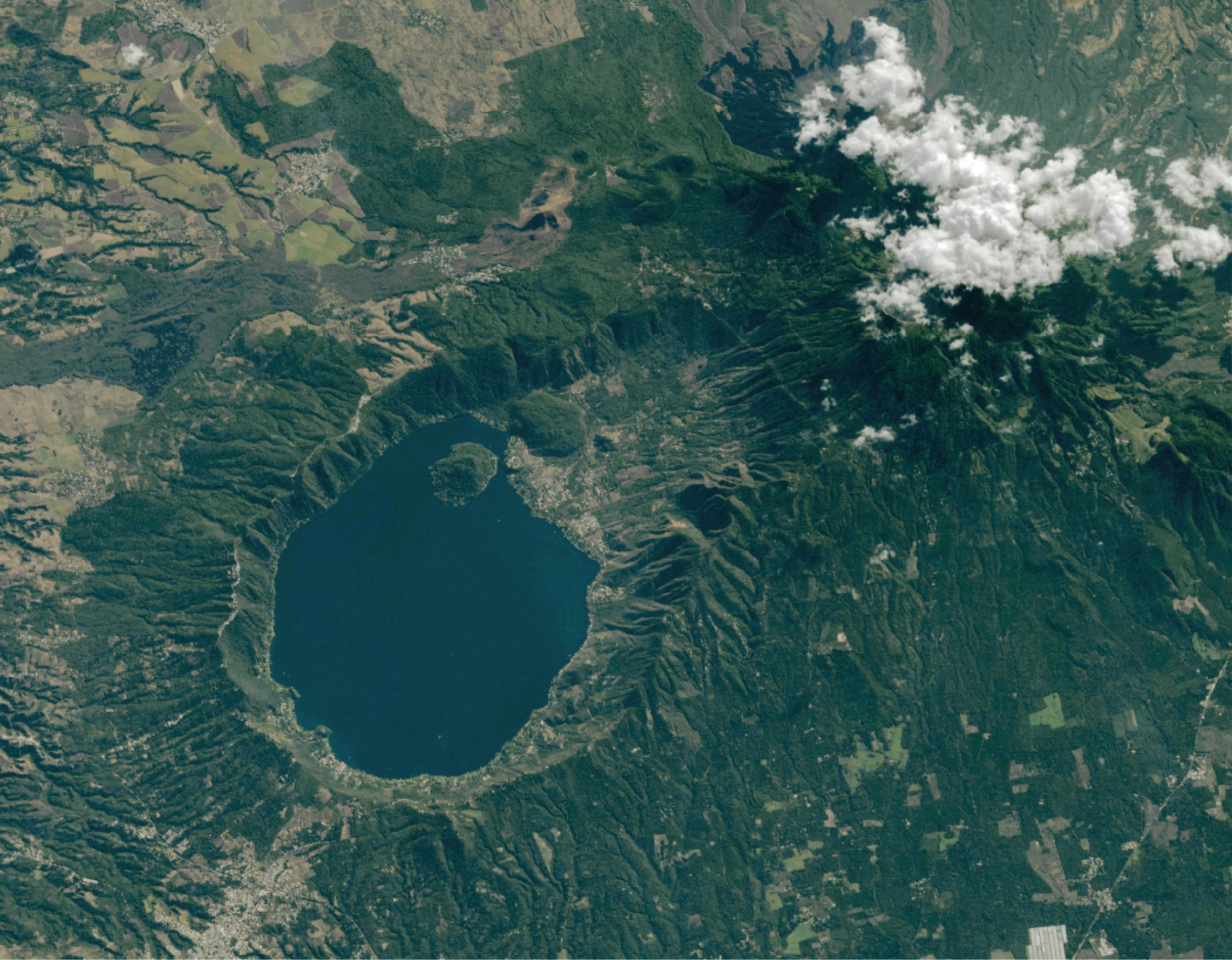
Calderas

Properties

  • Polygenetic
  • Gravitational collapse when reservoir is emptied
  • Small → summit reservoir
  • Large
    • Long-term maturation of a large reservoir
    • Feeds one or multiple volcanoes
    • Ignimbrites = large pumice PDCs

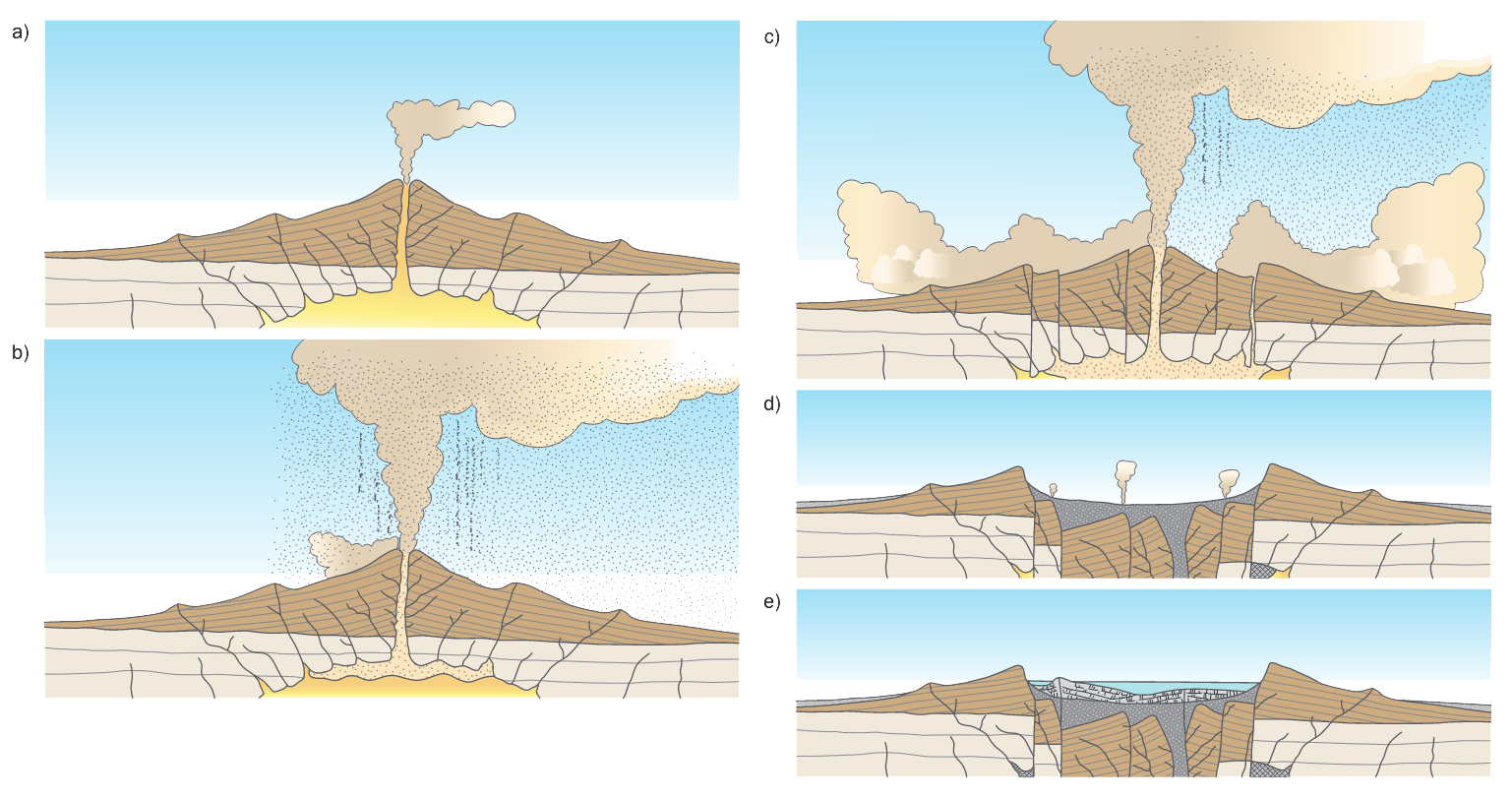
Formation of a large-scale explosive caldera. Lockwood et al. (2022)

Formation of a large-scale explosive caldera. Lockwood et al. (2022)

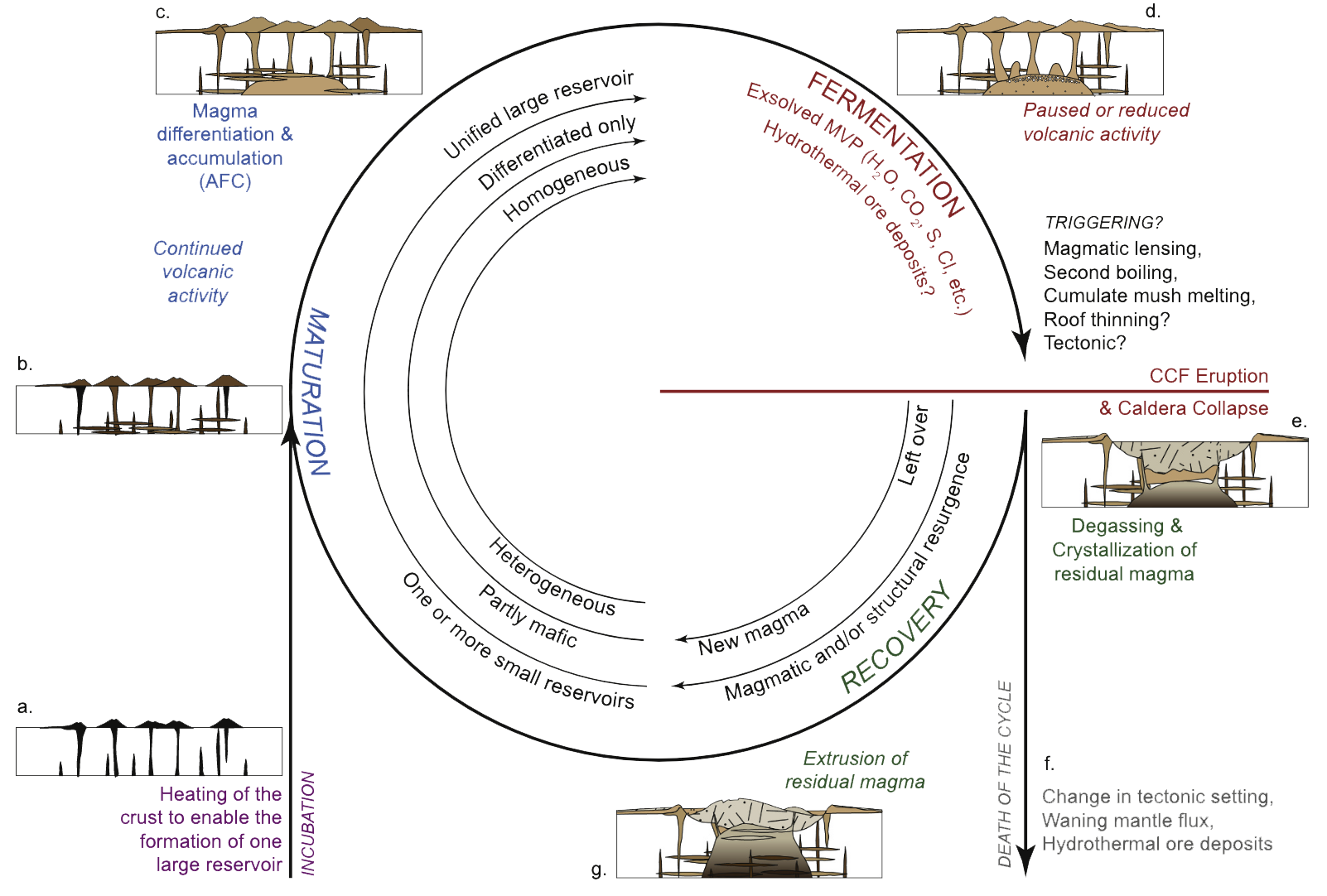
Caldera formation cycle. Bouvet De Maisonneuve et al. (2021)

Caldera formation cycle. Bouvet De Maisonneuve et al. (2021)

Processes

  • Conditions of magma reservoir emplacement?

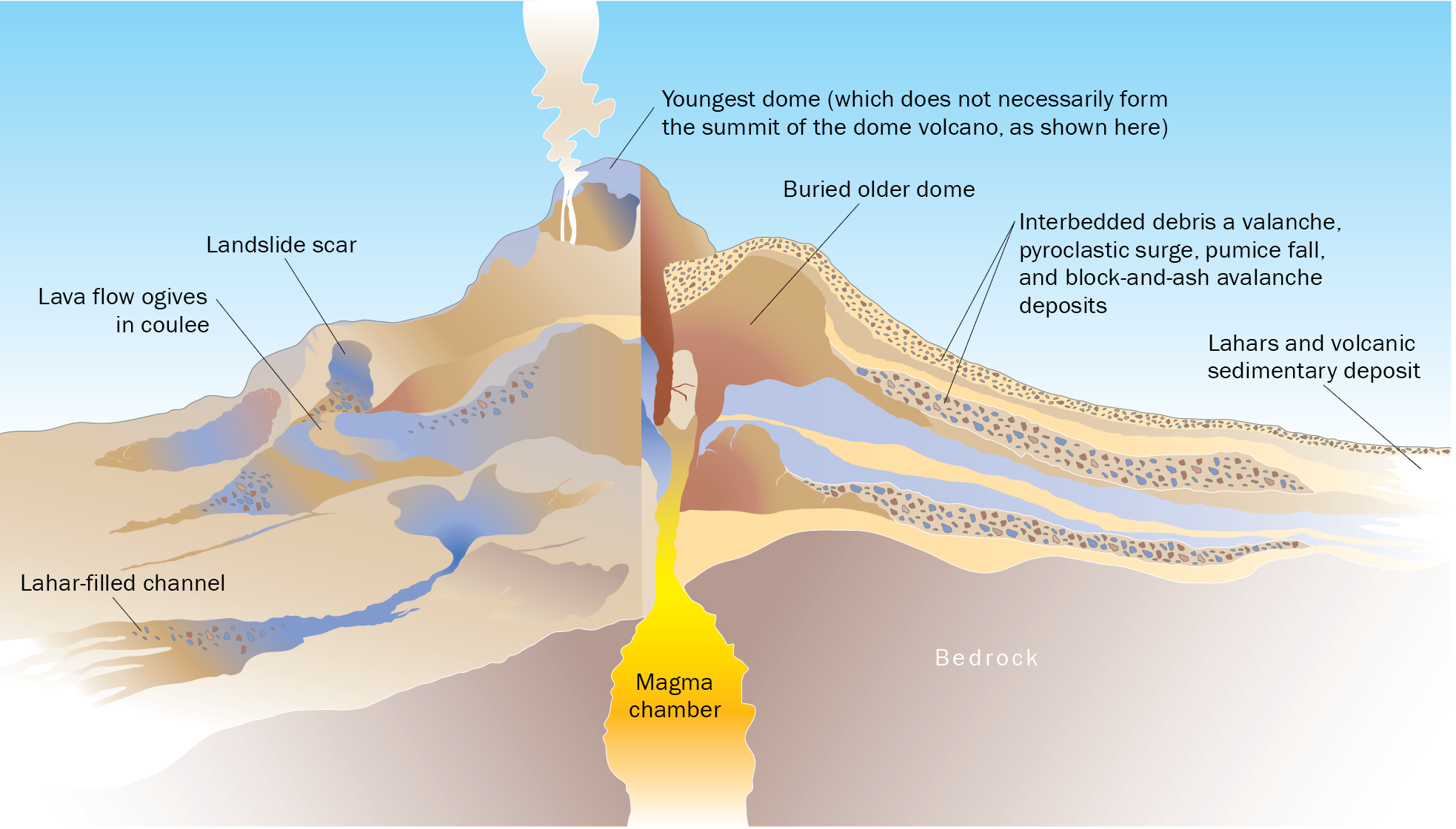
Domes

Properties

  • Polygenetic (→ composite) or monogenetic
  • Smooth shapes
  • Younger domes not necessarily at the summit

Processes

  • Rheology?
    • Rhyolitic domes?
    • Dacitic domes?
    • Andesitic domes?

Anatomy of a composite volcano made up of high-silica domes, pyroclastics, and related debris. Lockwood et al. (2022)

Anatomy of a composite volcano made up of high-silica domes, pyroclastics, and related debris. Lockwood et al. (2022)

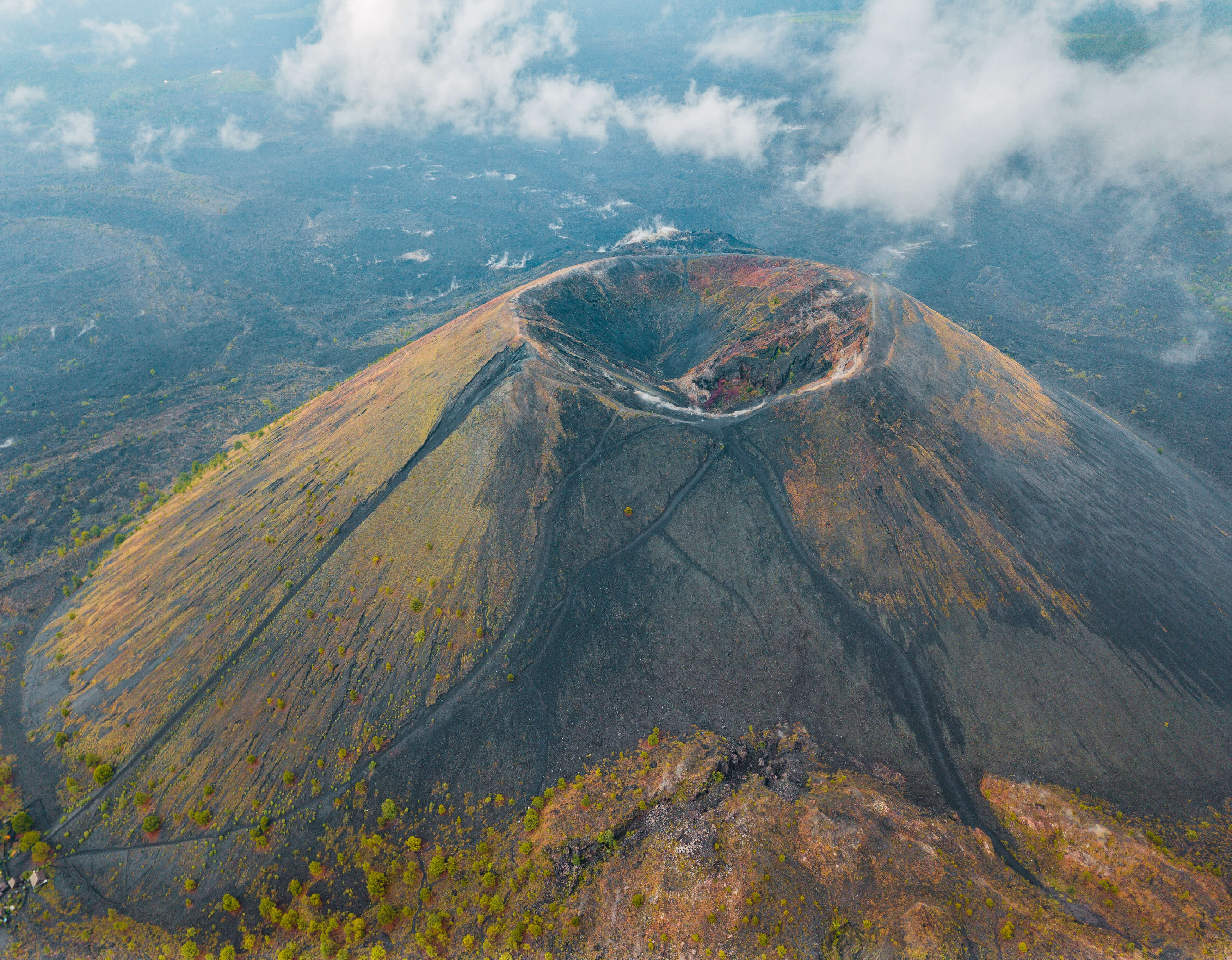
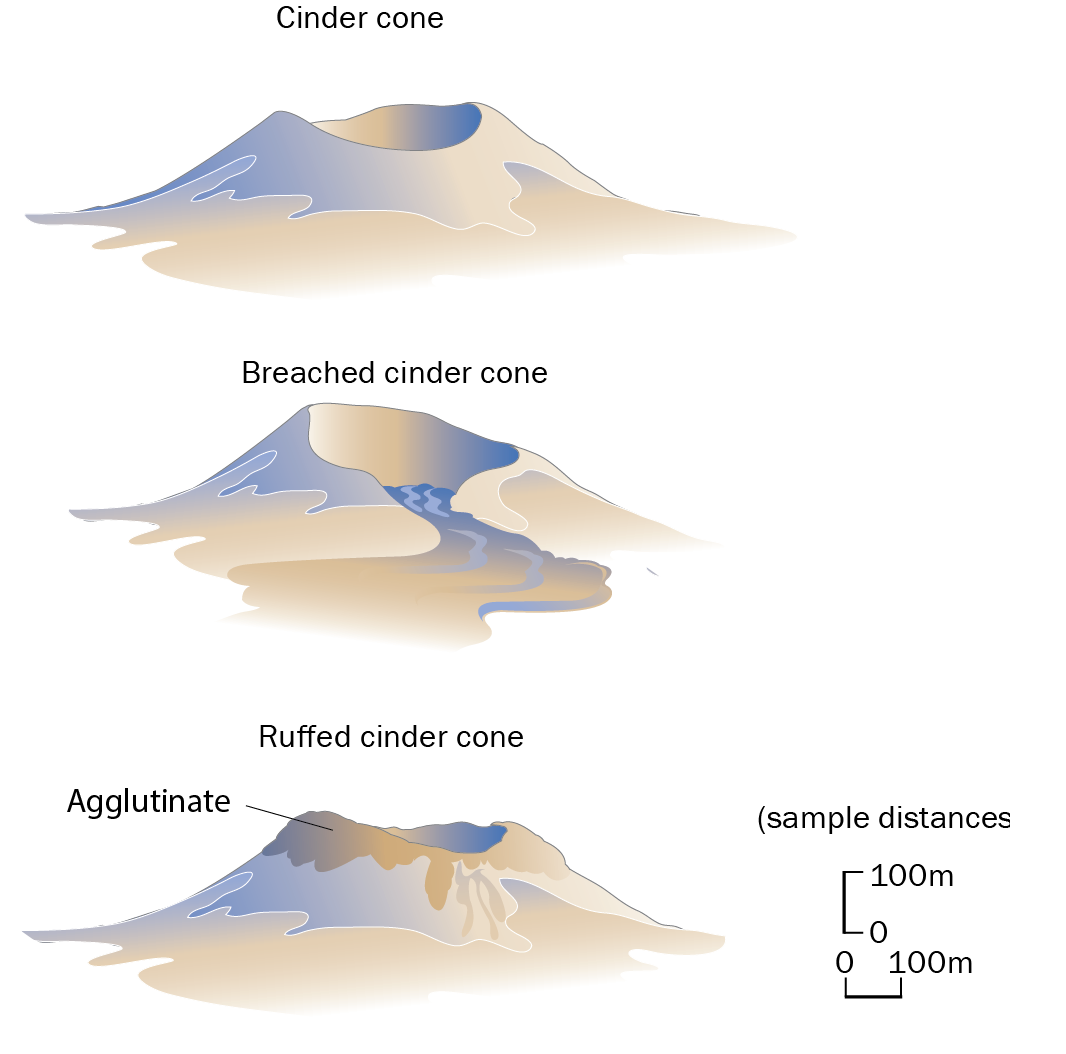
Cones

Properties

  • Monogenetic
  • Scorias/pumice cones
  • Alternation of
    • Fallout + PDC (proximal)
    • Lava flows
  • Can be breached → lava flow
  • Can be welded → fountains

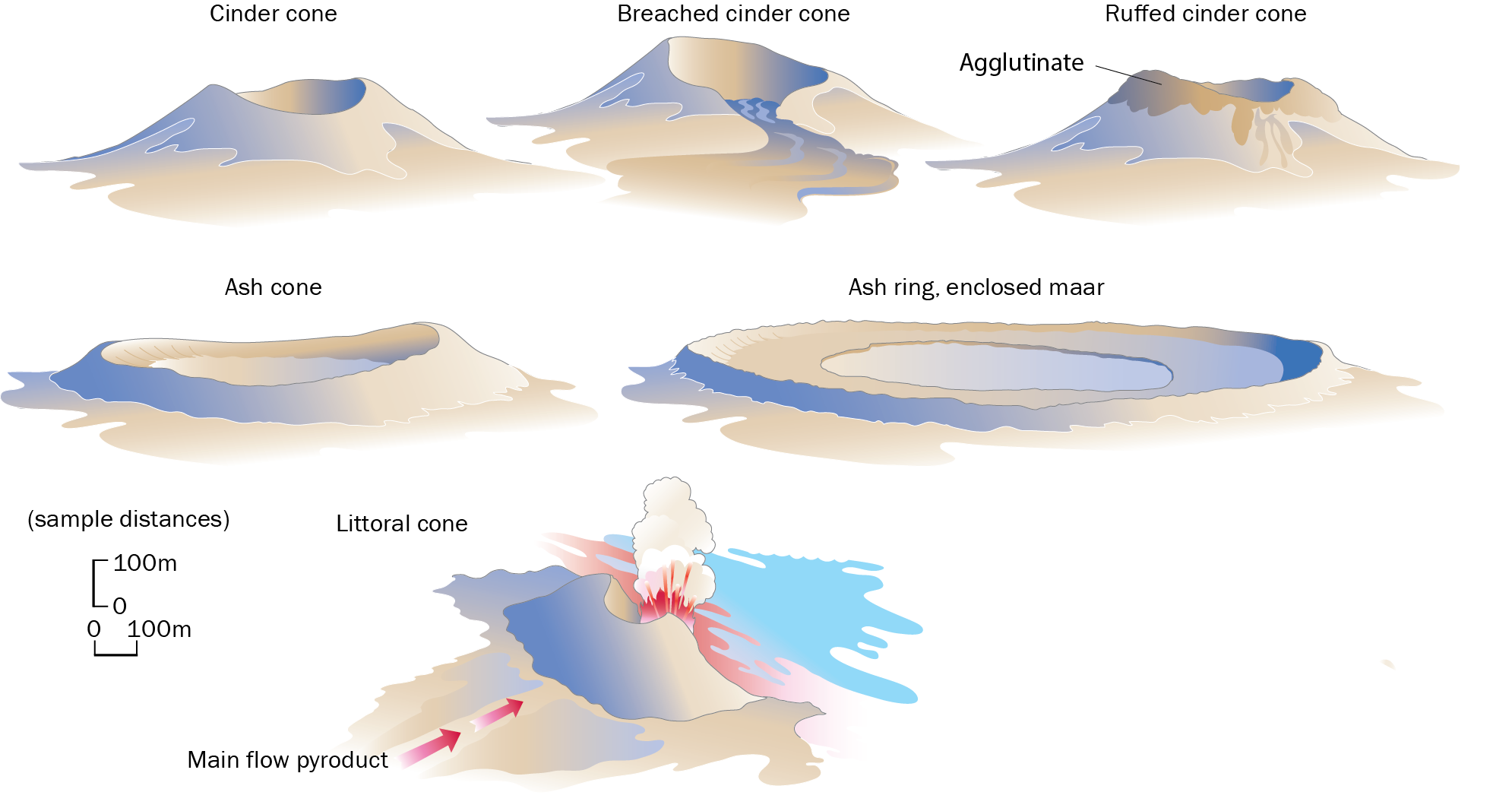
Types of “dry” volcanic cones. Lockwood et al. (2022)

Types of “dry” volcanic cones. Lockwood et al. (2022)

Hydrovolcanism

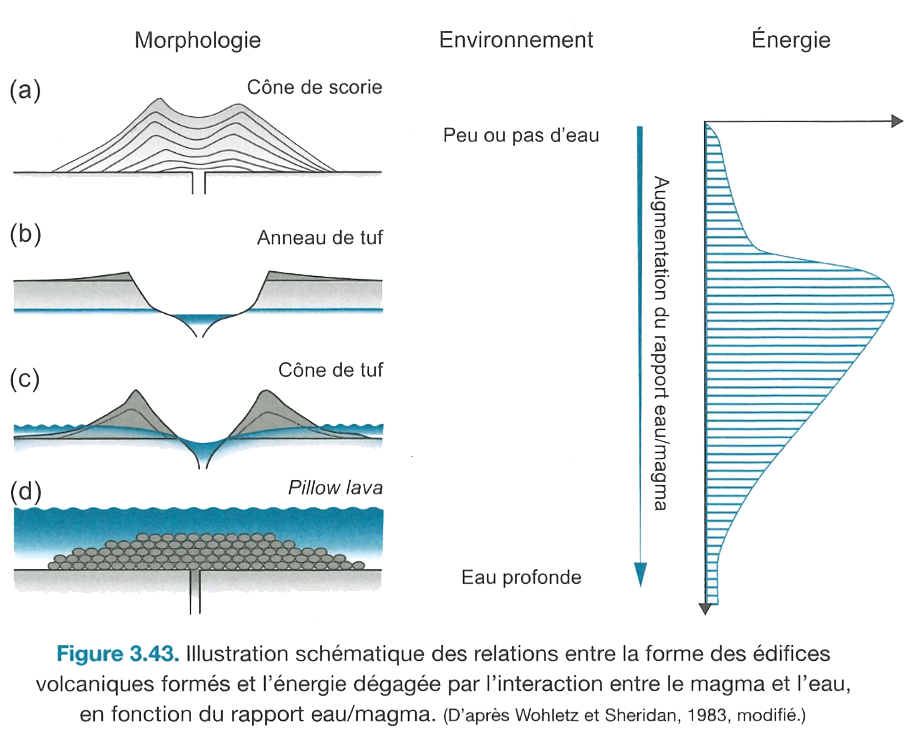
Contrast between “dry” and “wet” eruptions → sweet spot in ratio of water/magma
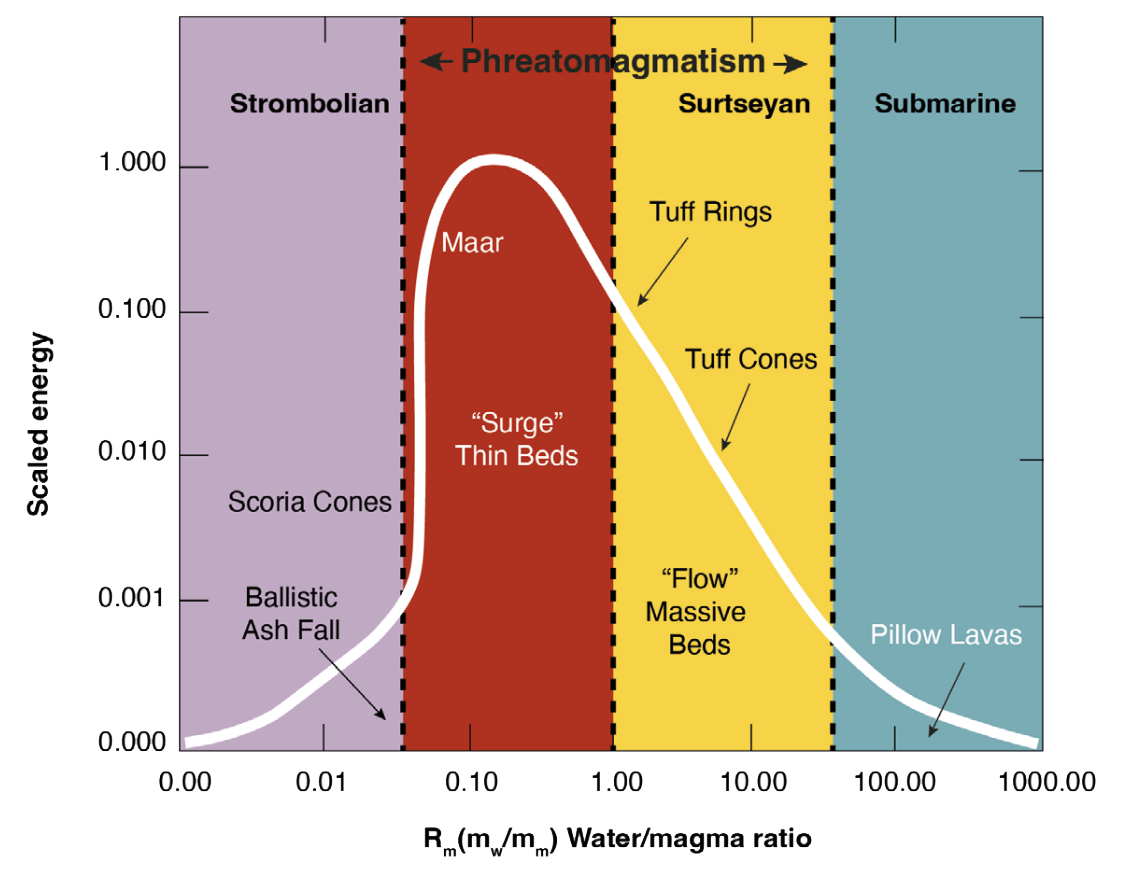
Scaled kinetic energy relative to the initial melt thermal energy is shown as a function of water/magma mass ratio. Karátson and Thouret (2025), after Sheridan and Wohletz (1983)

Scaled kinetic energy relative to the initial melt thermal energy is shown as a function of water/magma mass ratio. Karátson and Thouret (2025), after Sheridan and Wohletz (1983)

Chazot et al. (2017), after Sheridan and Wohletz (1983)

Chazot et al. (2017), after Sheridan and Wohletz (1983)

Lockwood et al. (2022)

Lockwood et al. (2022)

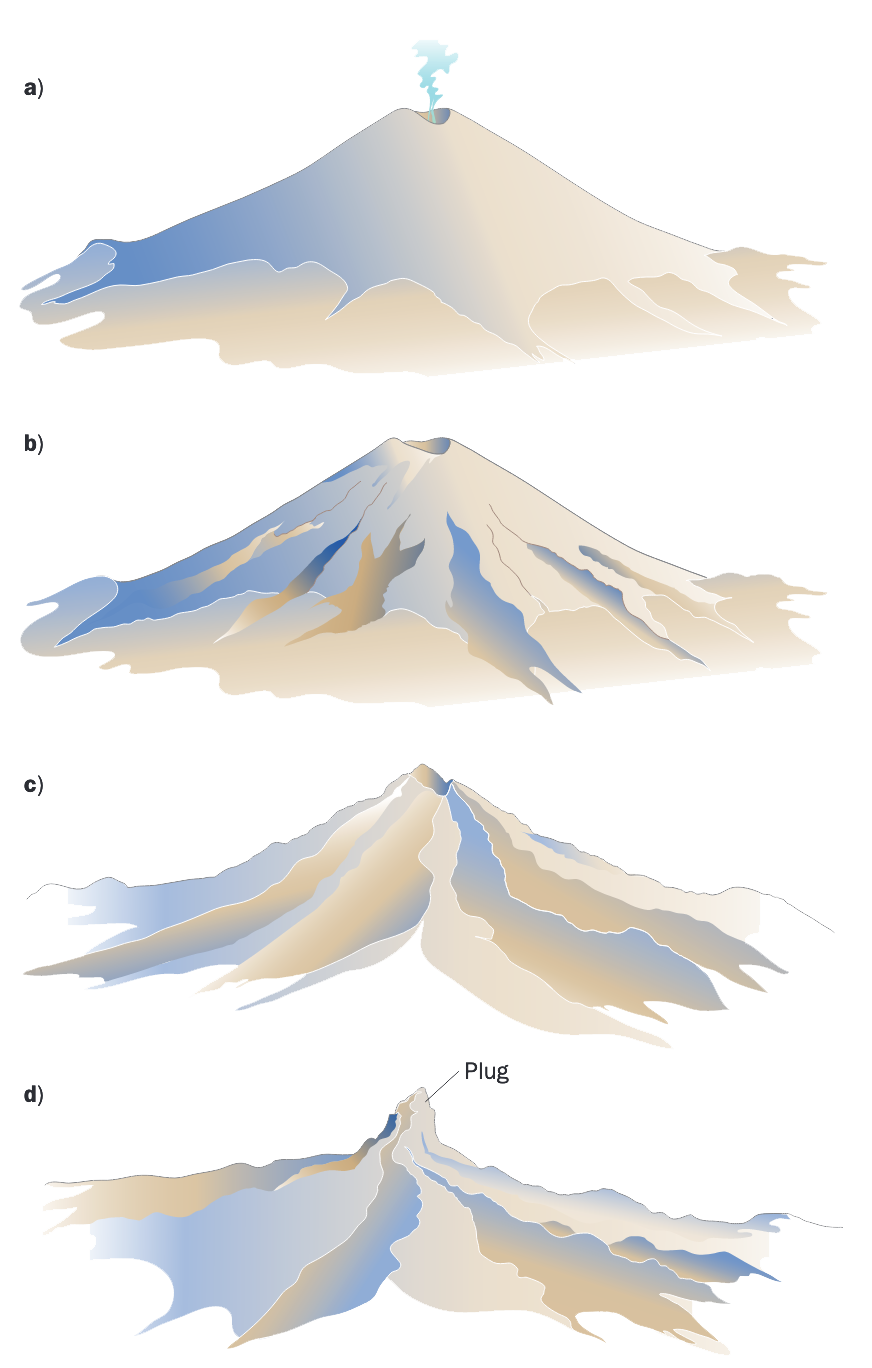
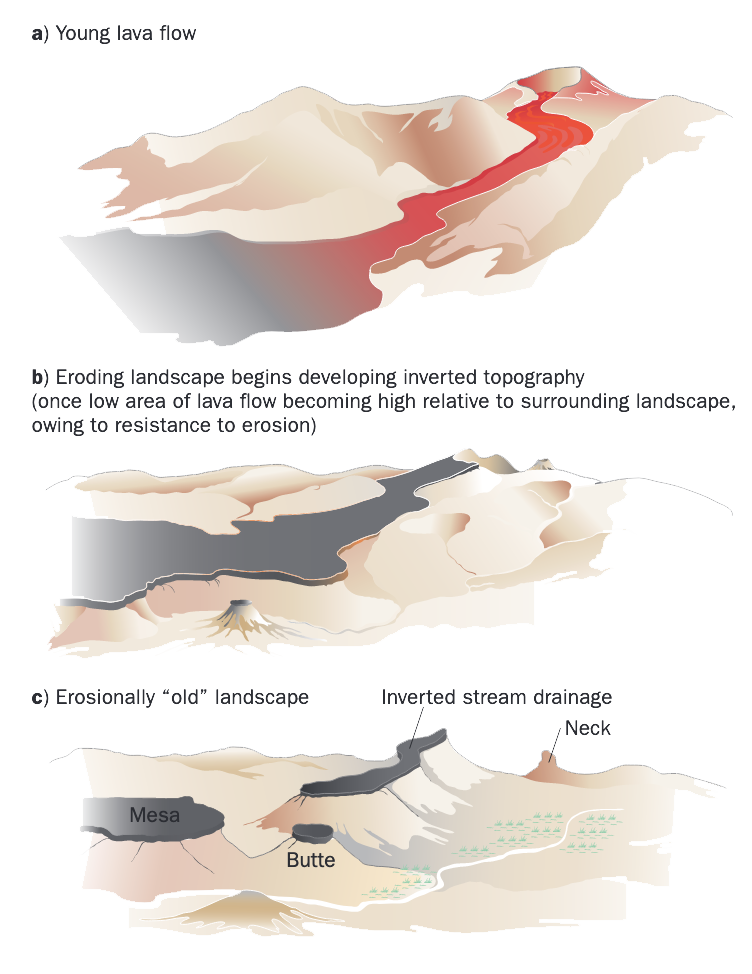
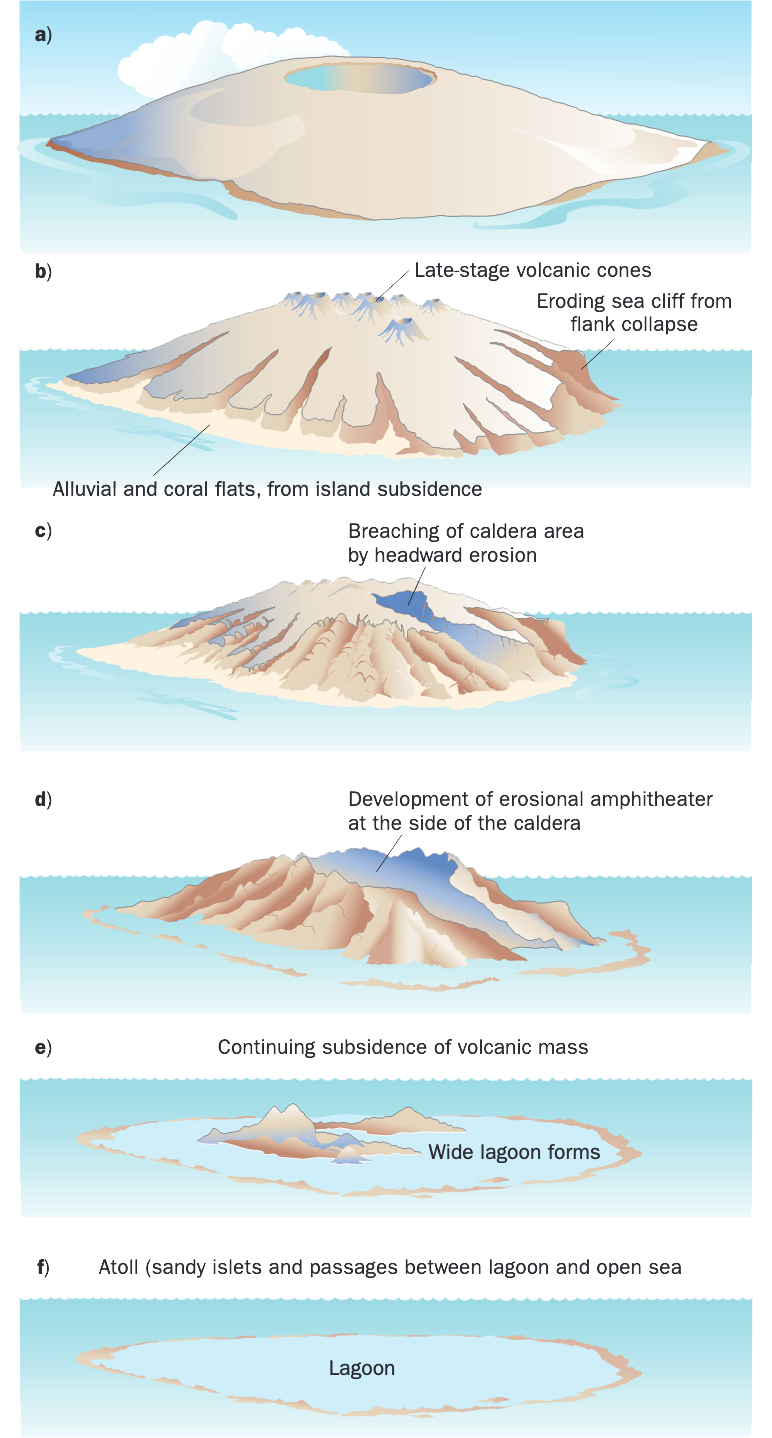
Erosional features

Erosion of a composite volcano. Lockwood et al. (2022)

Erosion of a composite volcano. Lockwood et al. (2022)

Erosion of cinder cone and a lava flow in a desert environment. Lockwood et al. (2022)

Erosion of cinder cone and a lava flow in a desert environment. Lockwood et al. (2022)

Erosion and tectonic subsidence of an oceanic shield volcano. Lockwood et al. (2022)

Erosion and tectonic subsidence of an oceanic shield volcano. Lockwood et al. (2022)

Eruptive styles

Lacroix

Class Description
Hawaiian Effusive eruptions of lava with little or no explosive activity apart from lava fountaining. Primarily basaltic. Originate at fissure vents. Associated with building of shield volcanoes and flood-basalt plains.
Strombolian Moderately explosive eruptions producing cinder, bombs, and ash which are initially incandescent as they leave the vent. Blasts often periodic, associated with bursting of very large gas bubbles in the vent. Typically basaltic and andesitic, with steam-rich light-colored ash clouds.
Violent Strombolian Eruptions resembling those of “normal” Strombolian activity, but producing notably larger quantities of fine ash, perhaps due to greater involvement of groundwater.
Vulcanian Moderate to violent ejection of solid fragments of cold rock, or of solid, recently hardened lava . Associated with the clearing of conduits, often plugged with domes. Blast clouds tend to be notably darker (more ash and less steam rich) than in the case of Strombolian eruptions. In addition to numerous blocks, large amounts of ash are produced.
Surtseyan Basaltic phreatomagmatic eruptions taking place in shallow water. Often rhythmic, like Strombolian eruptions, with largely white eruption clouds of dense steam.
Subplinian Weaker Plinian eruptions
Plinian Highly violent eruption of large amounts of pumice and ash, generally associated with PDCs. Airfall pumice beds and ash-flows, sometimes including ignimbrites, are characteristic. Caldera collapse is often associated with Plinian eruptions. Eruption columns 20–55 km high penetrate the stratosphere, injecting large quantities of water and sulfur aerosols into the upper atmosphere.
Phreatoplinian Plinian eruptions taking place through shallow bodies of water. Abundance of ash, accretionary lapilli, pyroclastic surge beds, etc., is much greater in Phreatoplinian deposits than in Plinian deposits. PDCs in such eruptions are extremely powerful and highly mobile.

Orange → part of the original early 20th century Lacroix classification. Blue → added later in the 70s

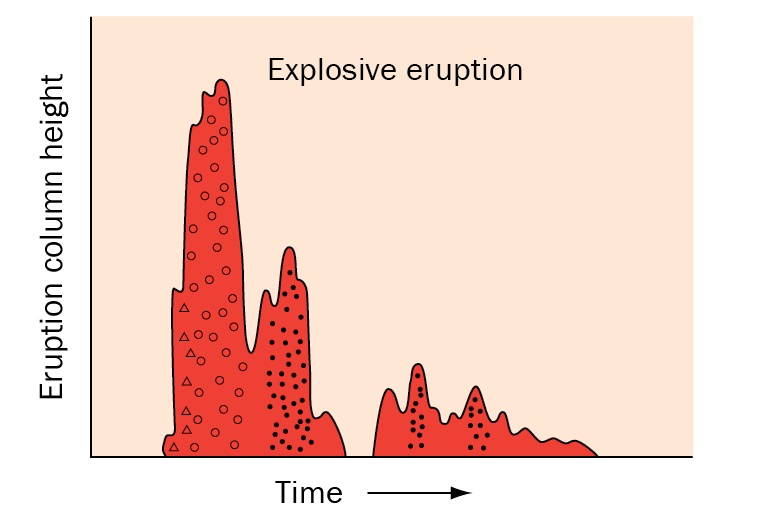
Eruption style 1

Eruption style 2

Rittman (1962)

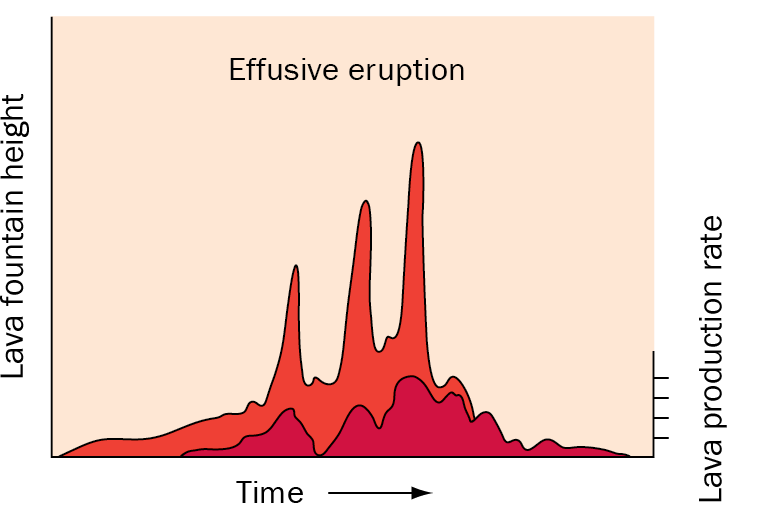
Height of lava fountains (light red) and lava effusion rates (dark red) plotted against time.

Height of lava fountains (light red) and lava effusion rates (dark red) plotted against time.

Triangles = vent clearing, circles = PDC, dots = ash, clear = no ash

Triangles = vent clearing, circles = PDC, dots = ash, clear = no ash

Problem: How to infer this for past eruptions from the stratigraphy?

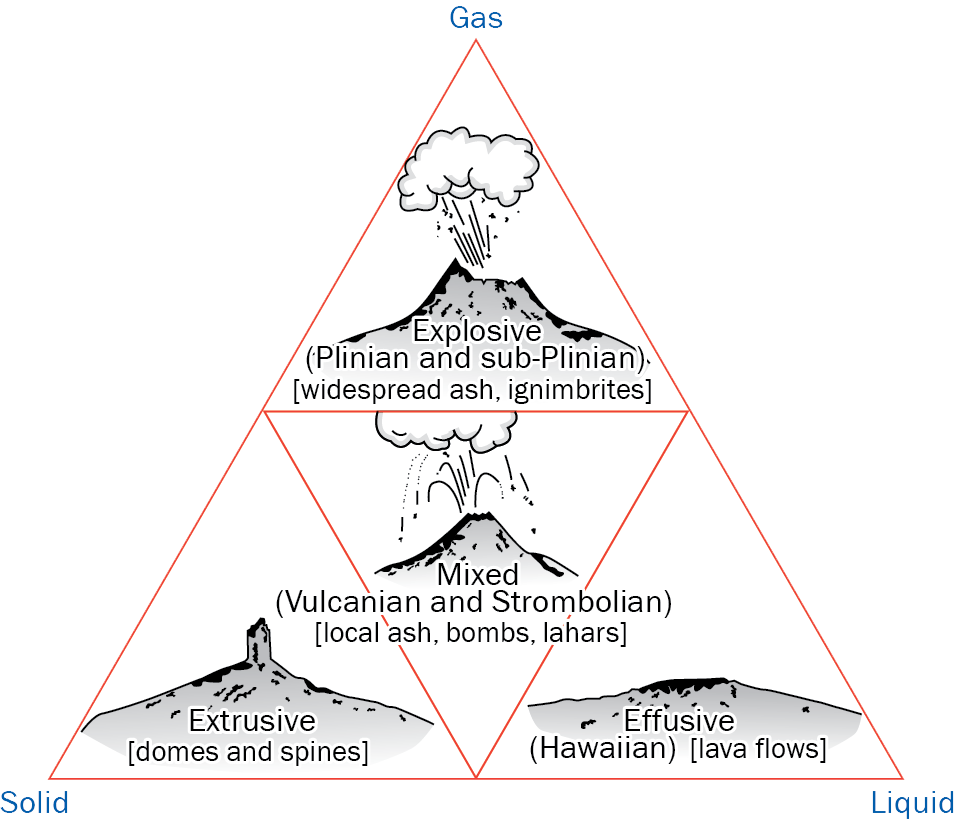
Geze (1964)

  • Graphical representation of Lacroix
  • Based on the proportion of gases, solids, and liquids erupted.
Walker (1973)
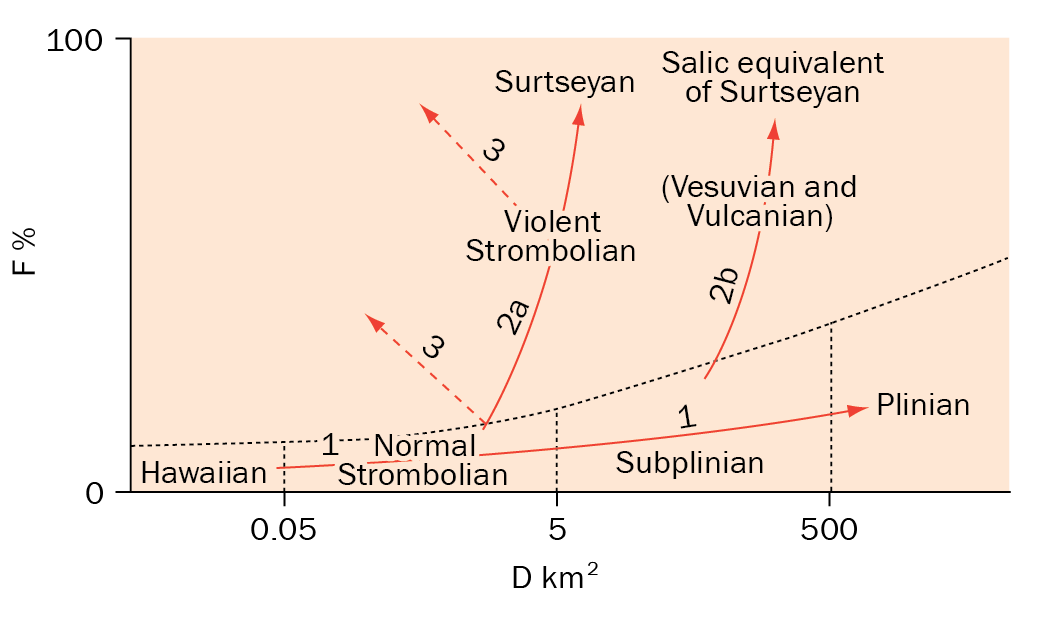
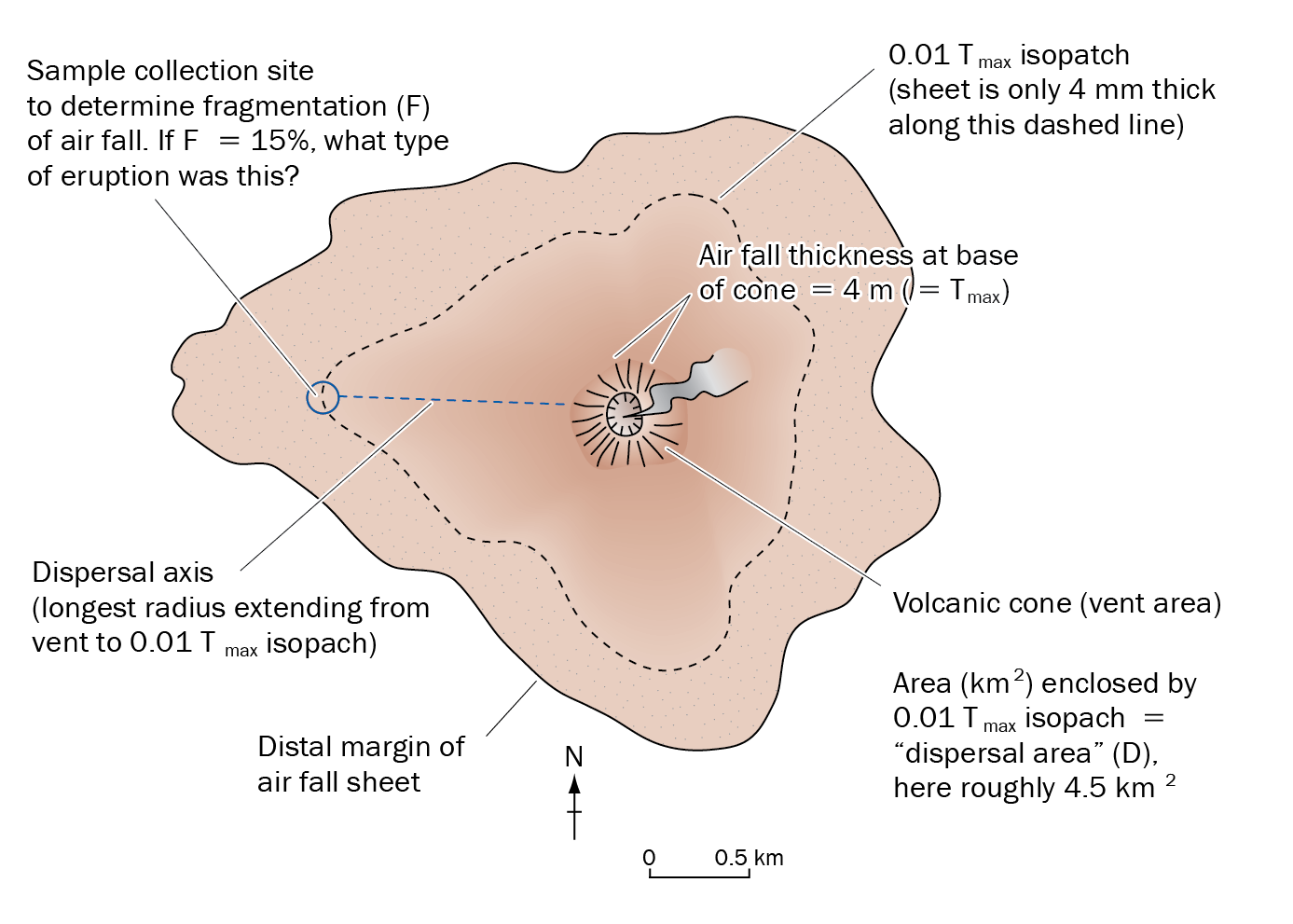
The F axis is percentage of ejecta in an air fall deposit with a grain size of less than 1 mm, as measured at the 0.01 Tmax

The F axis is percentage of ejecta in an air fall deposit with a grain size of less than 1 mm, as measured at the 0.01 Tmax

  • Framework to study past eruptions
  • Problem: Only explosive

Process-based classification schemes

Attempt to:

  • Be more quantitative
  • Capture the dynamics of eruptions
    • Switches in eruption styles during one eruption
  • Problem: An increasing number of parameters complicates the characterization of the eruption!
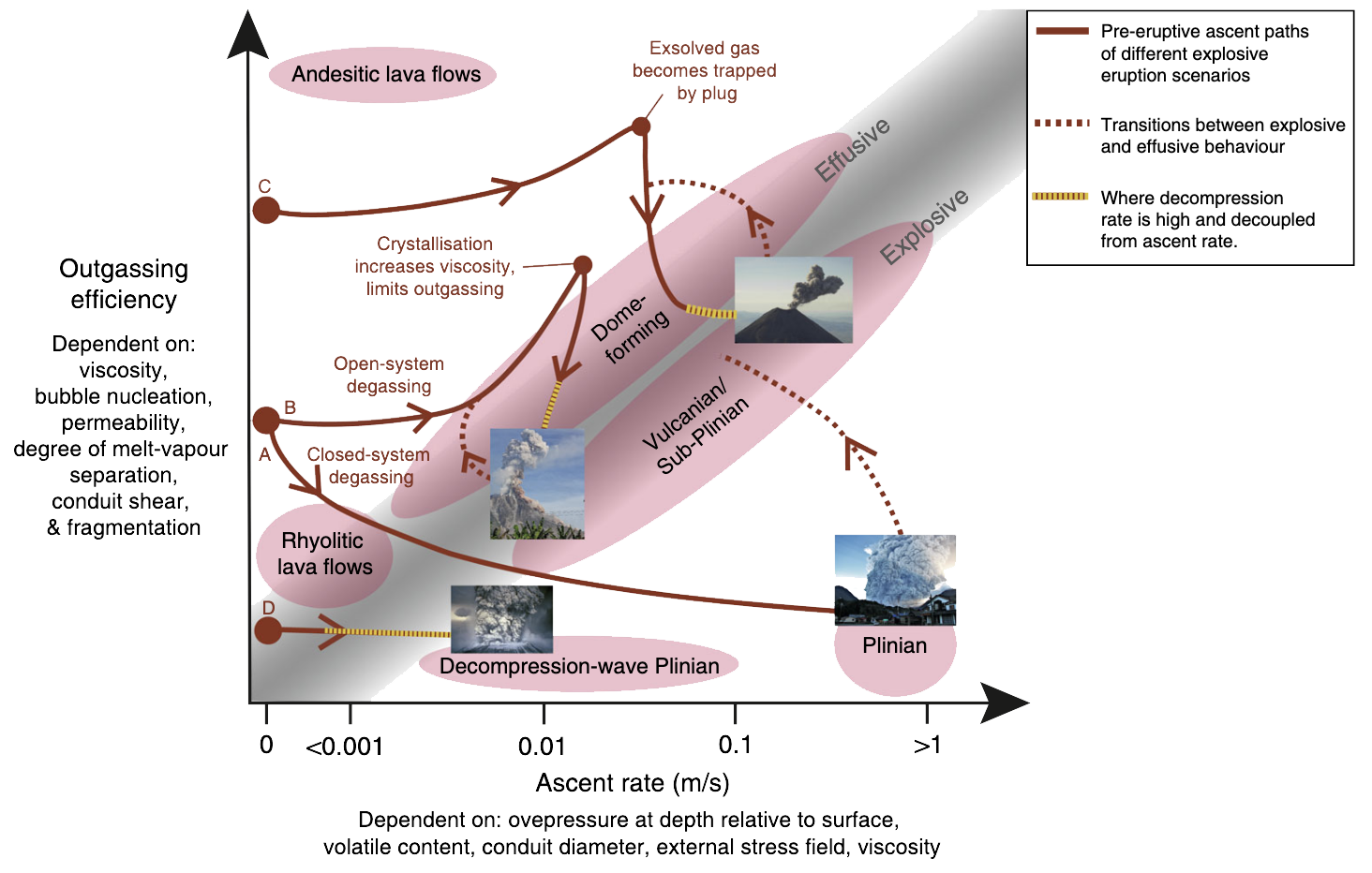
Cassidy et al. (2018)

Cassidy et al. (2018)

Points a–d represent different eruptive scenarios: a = Ascent controlled (bottom-up), b = Viscosity controlled, c = Exsolved gas accumulation and plug controlled, and d = Decompression-wave controlled. The red lines are pre-eruptive ascent paths and do not represent transitions between effusive and explosive behaviour, where the eruption photo represents a magma reaching the surface. The starting position on the outgassing efficiency axis depends on the magma rheology (composition and crystallinity) and permeability.

Eruption quantification

Risk equation


Risk = f(Hazard, Exposure, Vulnerability, Value, Resilience)x,y,t


  • Hazard: Where? When? What? How big?
    • Need to estimate the probability of occurrence in space and time
  • Exposure: What? → Population, Buildings, Infrastructures
  • Vulnerability: How negatively impacted will exposed elements be?
  • Value: How many? → Quantity, Economic value
  • Resilience: How to face, how to reduce the impact ?

MSH

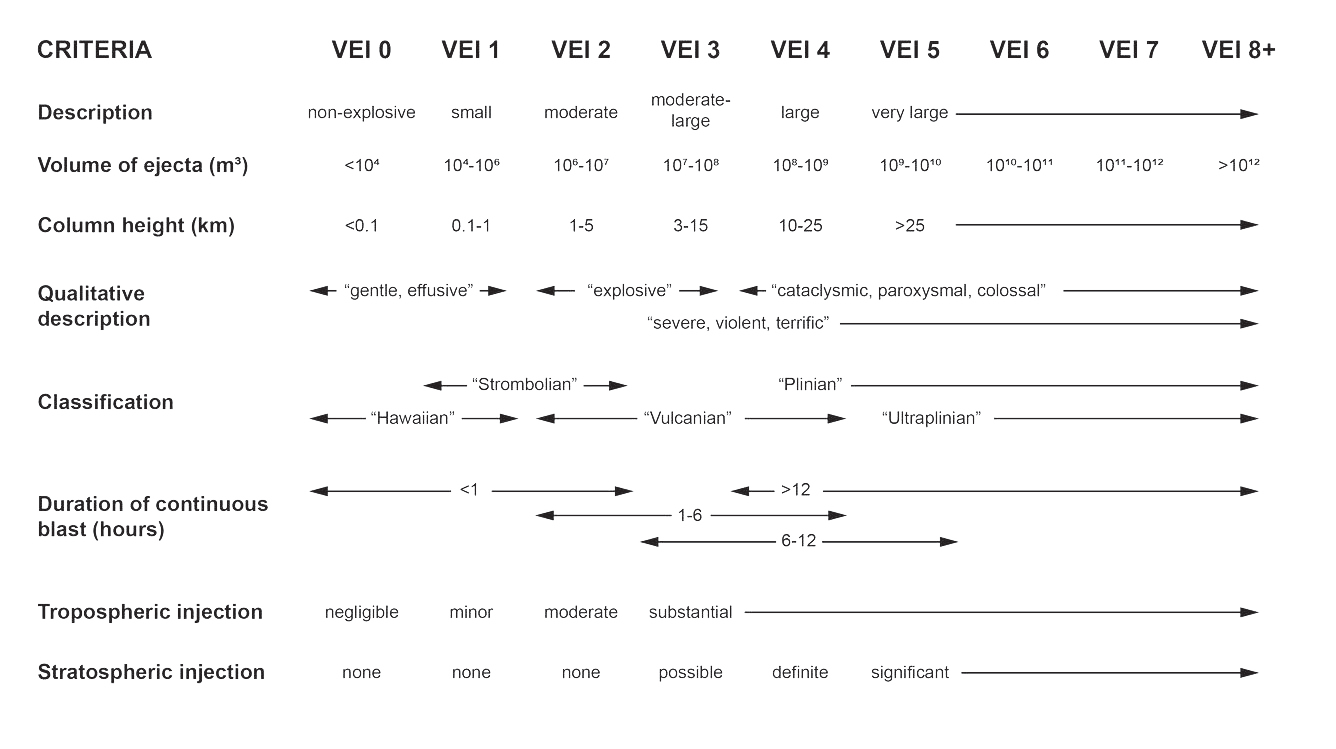
Volcanic explosivity index

Newhall and Self (1982)

Newhall and Self (1982)

VEI: pros and cons

  • Designed for communication
  • Based on tephra volume ± qualitative indicators
    • Allows quantification of past eruptions

Problems

  • Only for explosive eruptions
  • Stepwise
  • Anything missing?

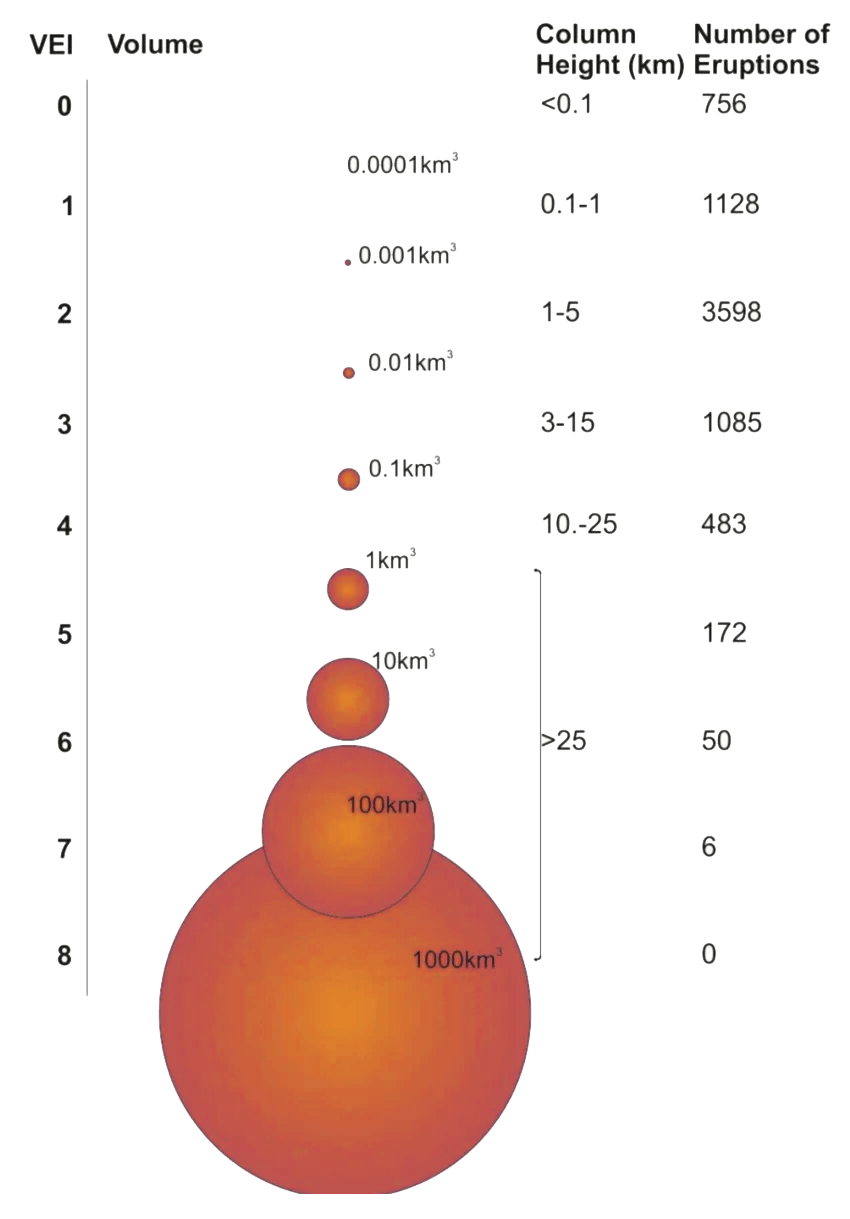
Newhall and Self (1982)

Newhall and Self (1982)

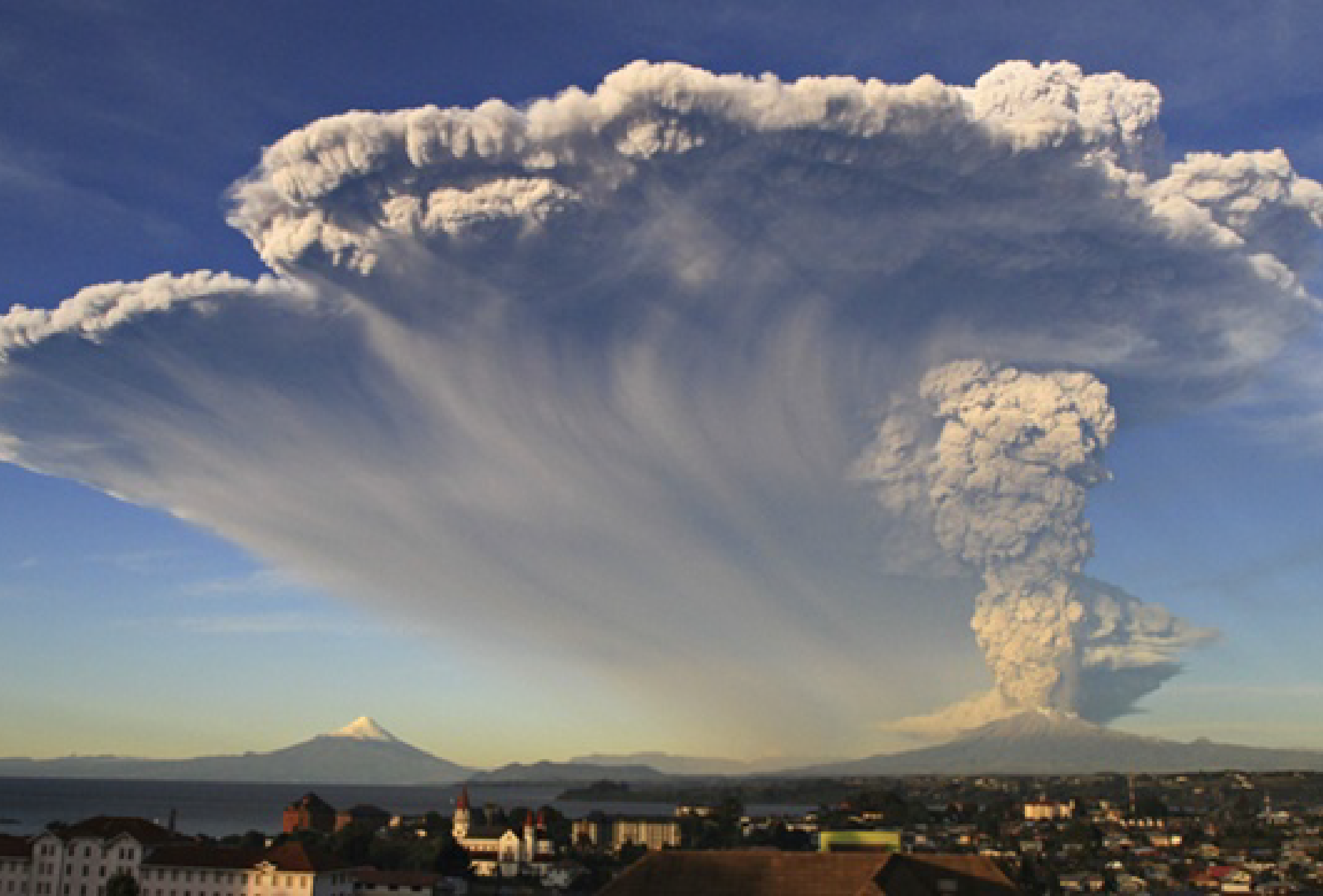
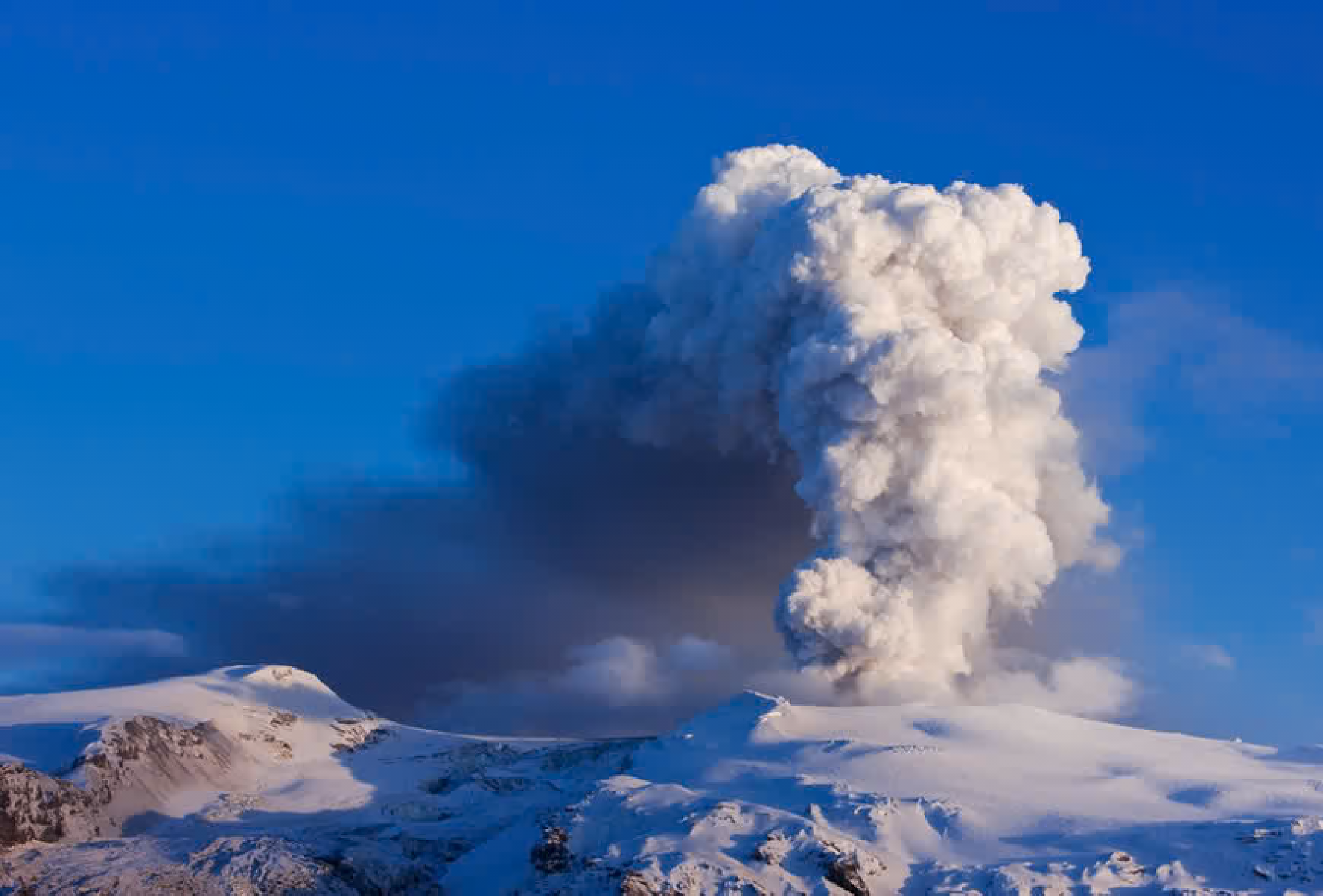
Same same but different

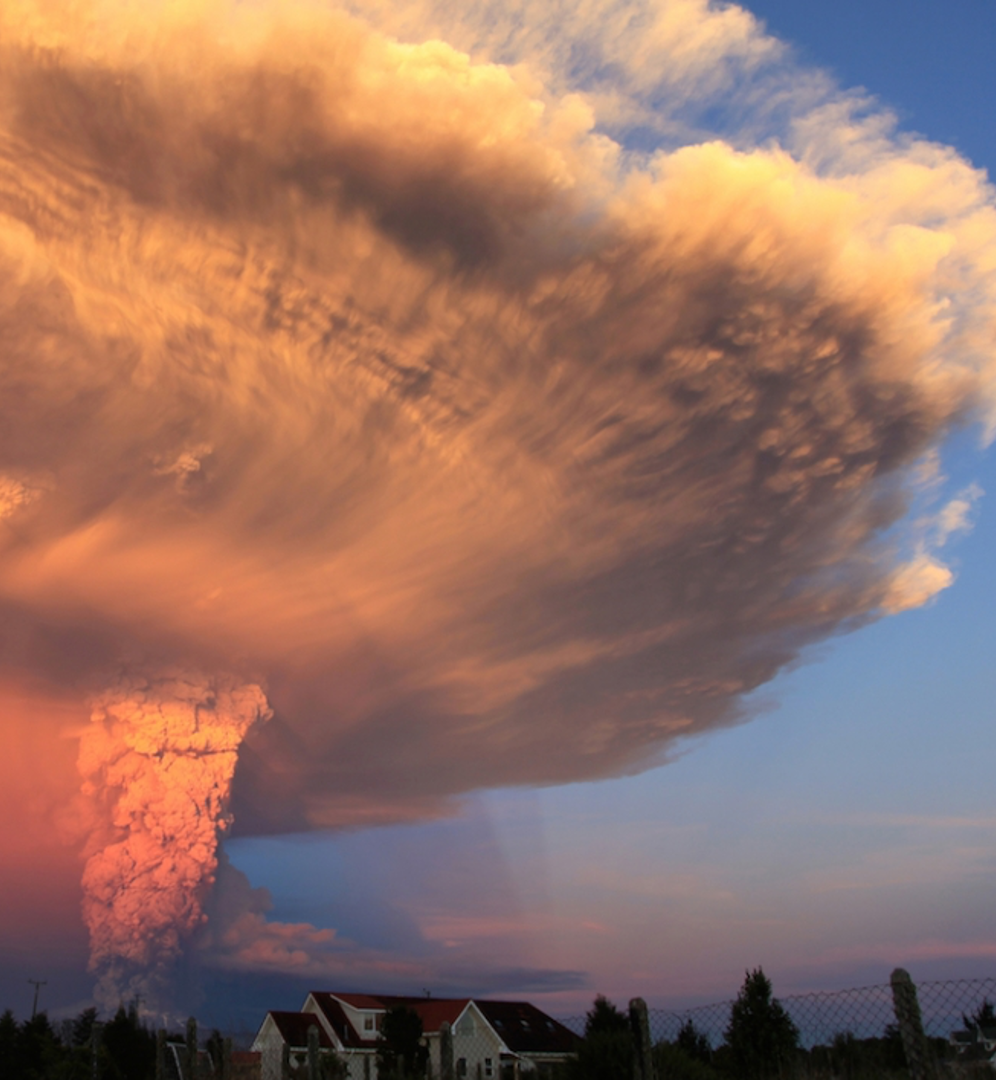
  • Calbuco 2015: VEI4
    • Hours-days, Height = 15-20 km asl
  • Eyjafjallajökull: VEI4
    • Weeks-months, Max height = 6-9 km asl

Magnitude & intensity

Intensity:

→ \(log_{10}(MER\ [kg s^{-1}]) + 3\)

Magnitude:

→ \(log_{10}(Mass\ [kg]) - 7\)
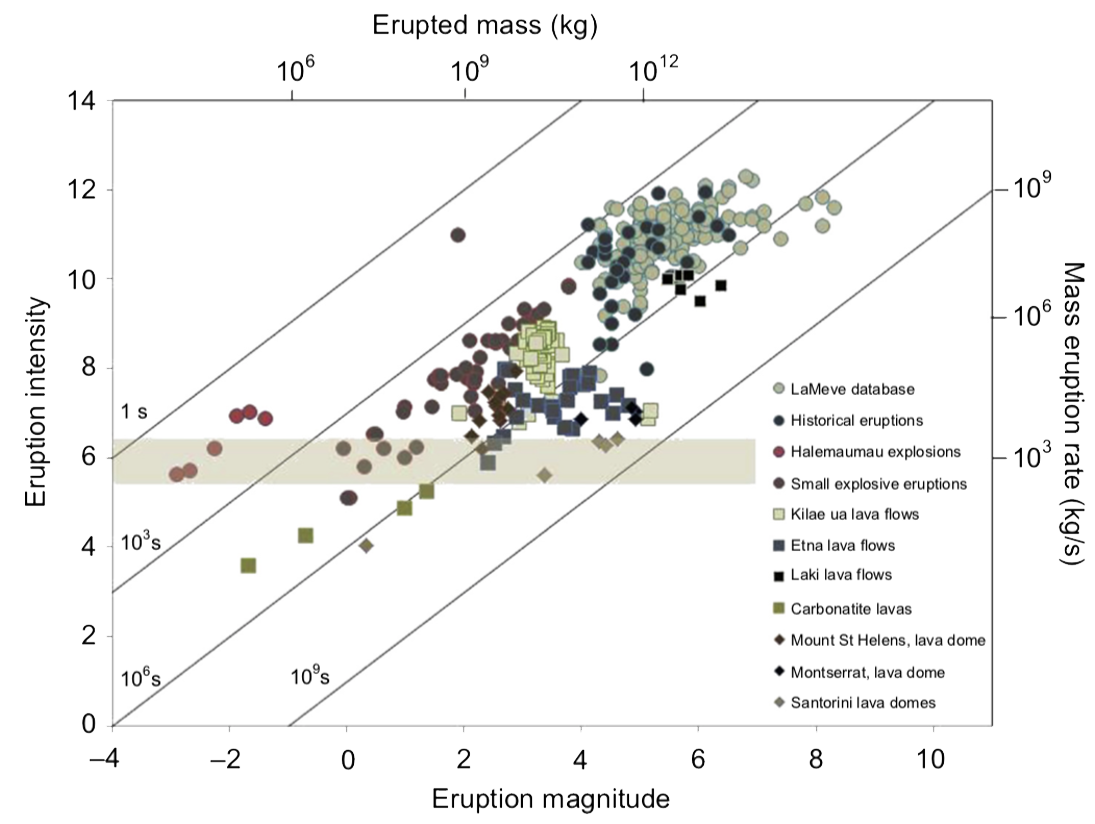
Pyle (2015)

Pyle (2015)

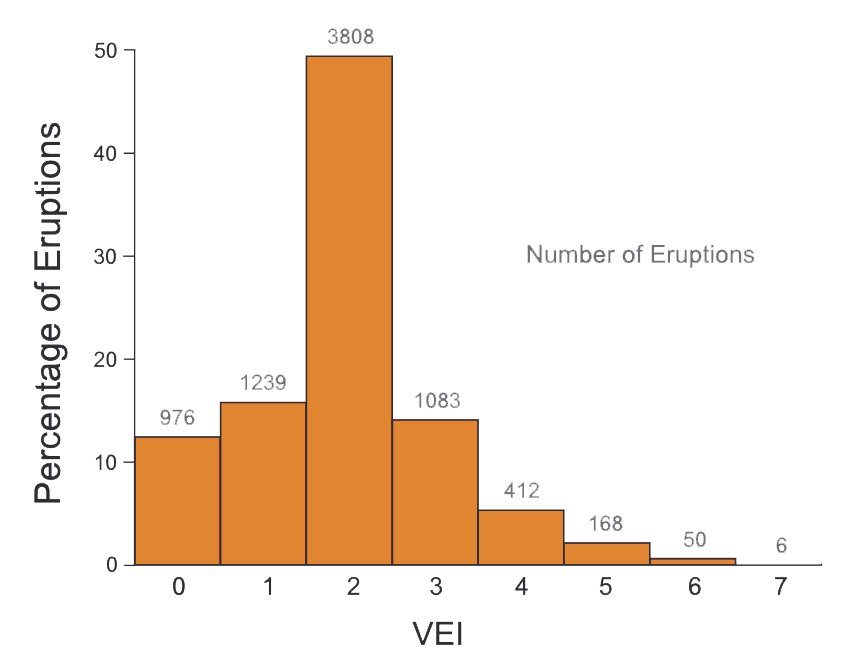
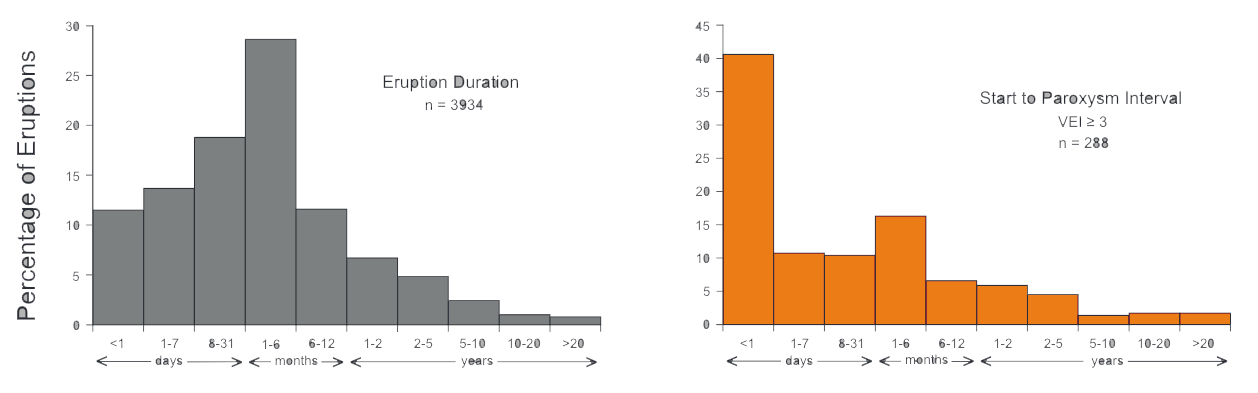
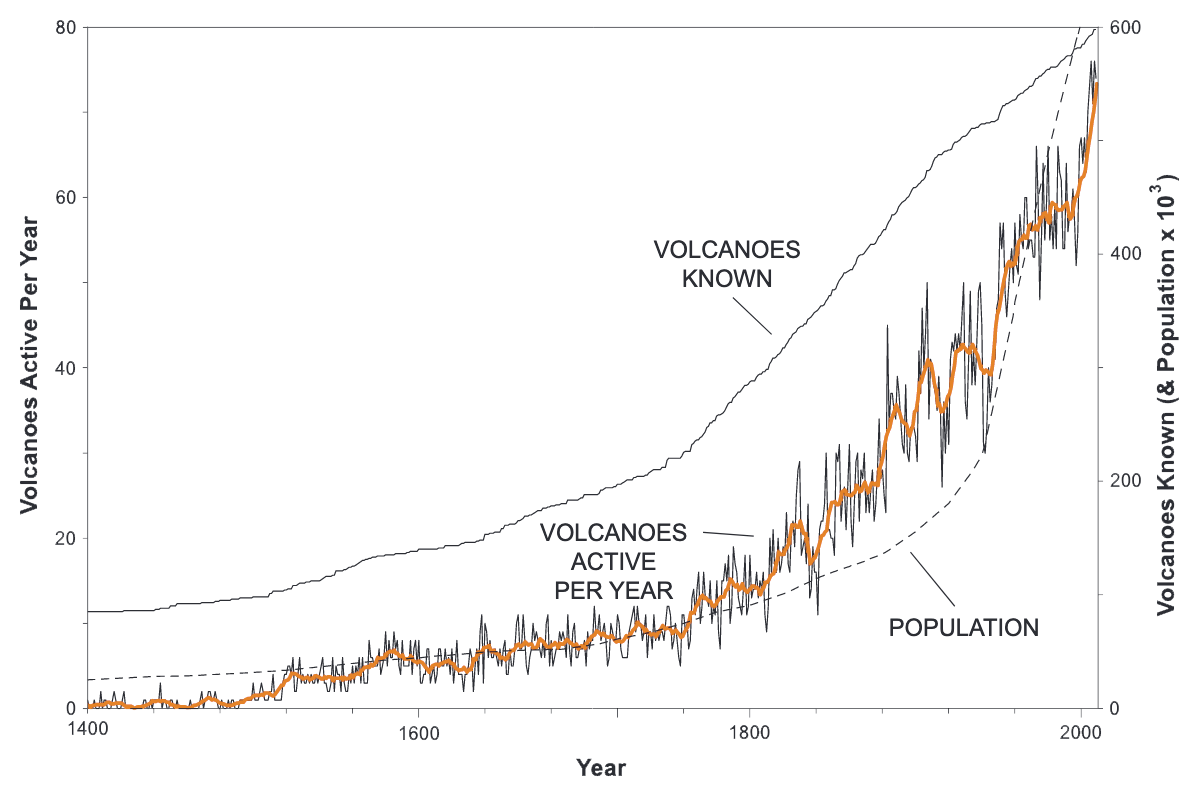
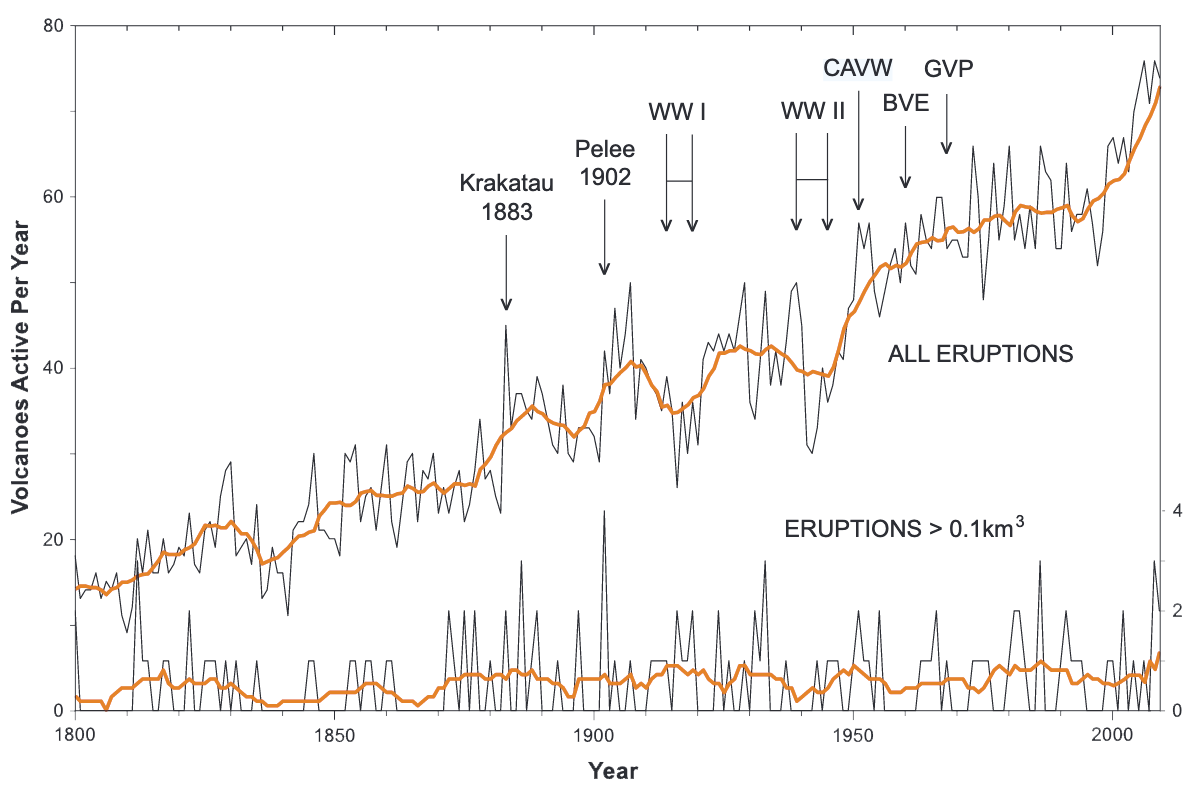
The Holocene eruption record

Simkin et al. (2010)

Simkin et al. (2010)

Simkin et al. (2010)

Simkin et al. (2010)

Geological vs historical biases


Historical bias:

  • Many small eruptions in historical times
  • Limited record of large eruptions

Geological bias:

  • Larger record of large eruptions
  • Small eruptions lost in the stratigraphic record (→ erosion)

Simkin et al. (2010)

Simkin et al. (2010)

Simkin et al. (2010)

Simkin et al. (2010)

Eruption frequencies

  • Several small eruptions per year
  • Moderate eruptions: every few decades (regional impact)
  • Large eruptions: every century or more
  • ~2 VEI 8 eruptions every 100,000 years
  • In general, large eruptions are preceded by long periods of quiescence
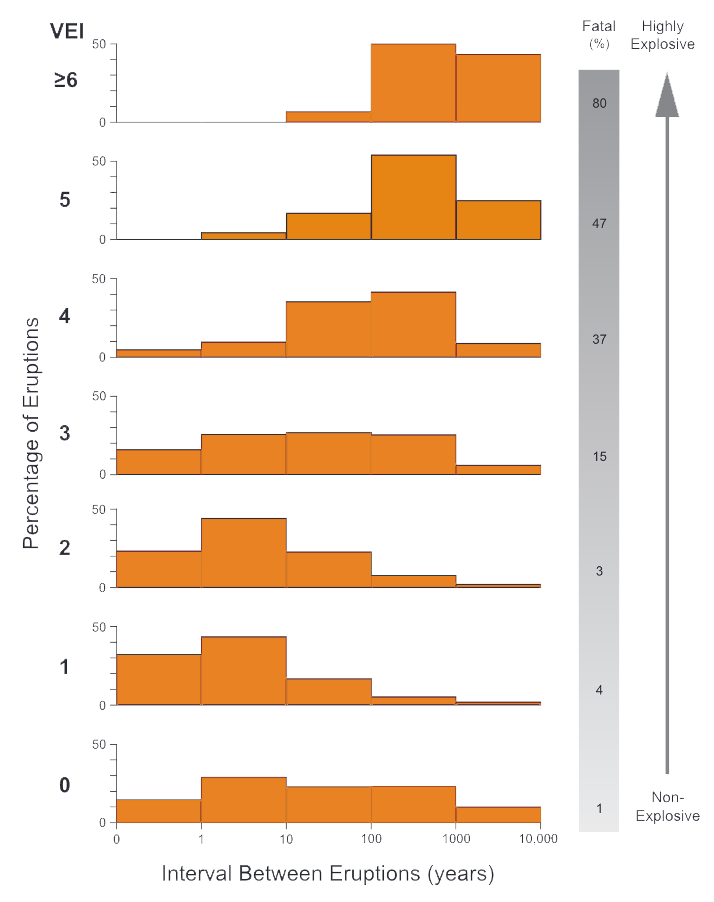
Simkin et al. (2010)

Simkin et al. (2010)

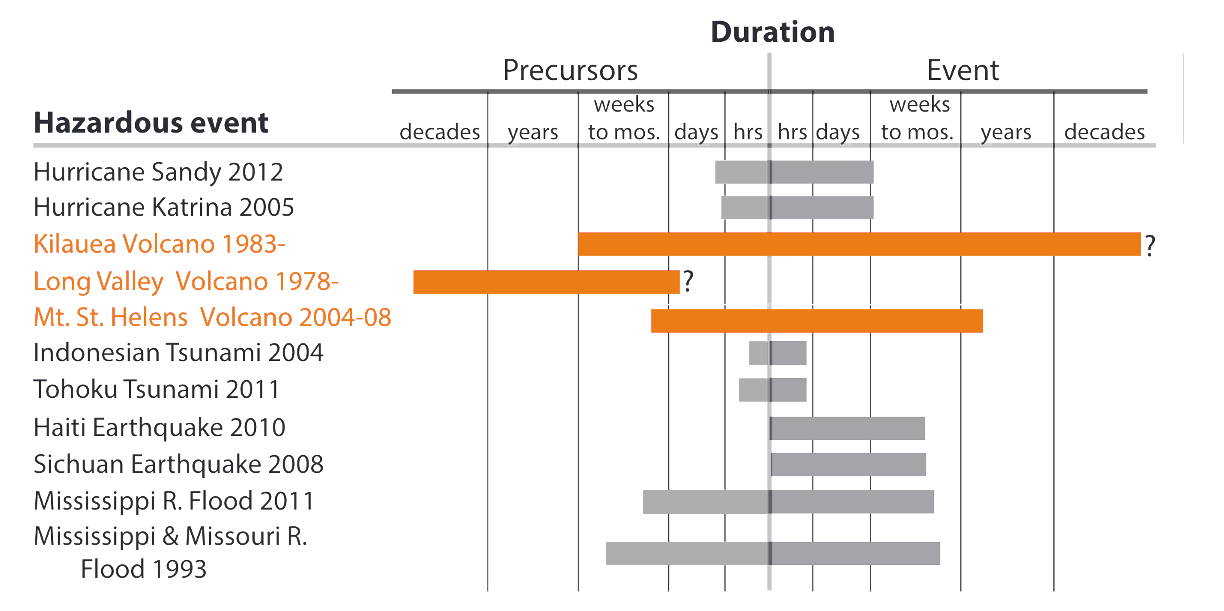
Challenge 1: Uncertainties

National Academy of Sciences (2017)

National Academy of Sciences (2017)

Grindavík: 3’000 people

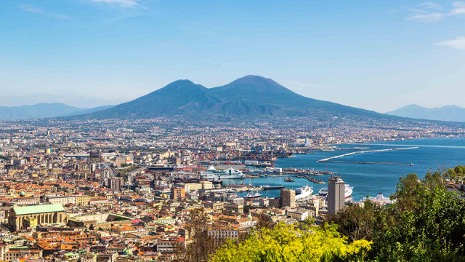
Naples: 700’000 people

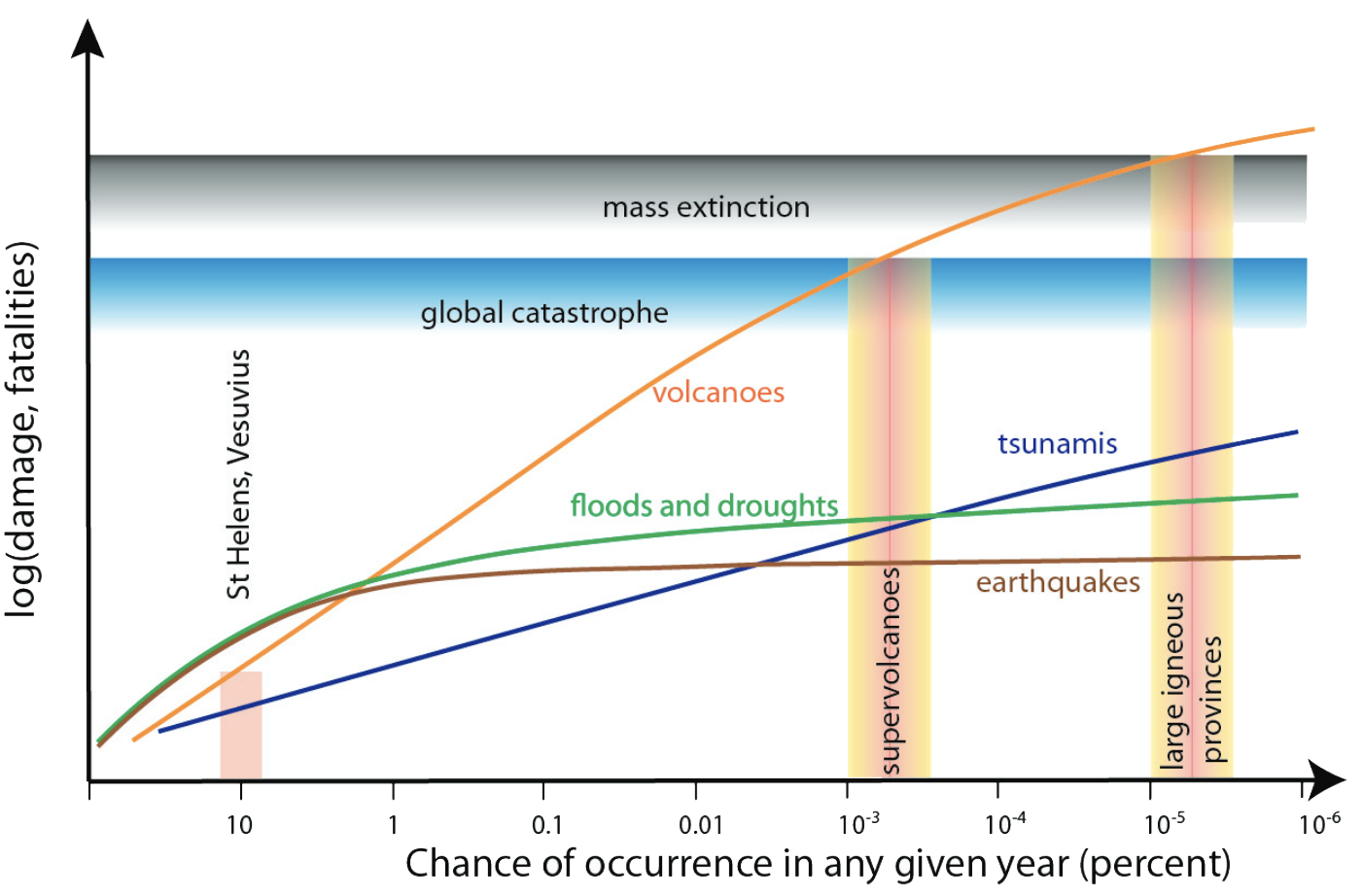
Challenge 2: Low probability - high impact

  • Large eruptions = Global Catastrophic Risk
    • We have never witnessed such an eruption → how to prepare?
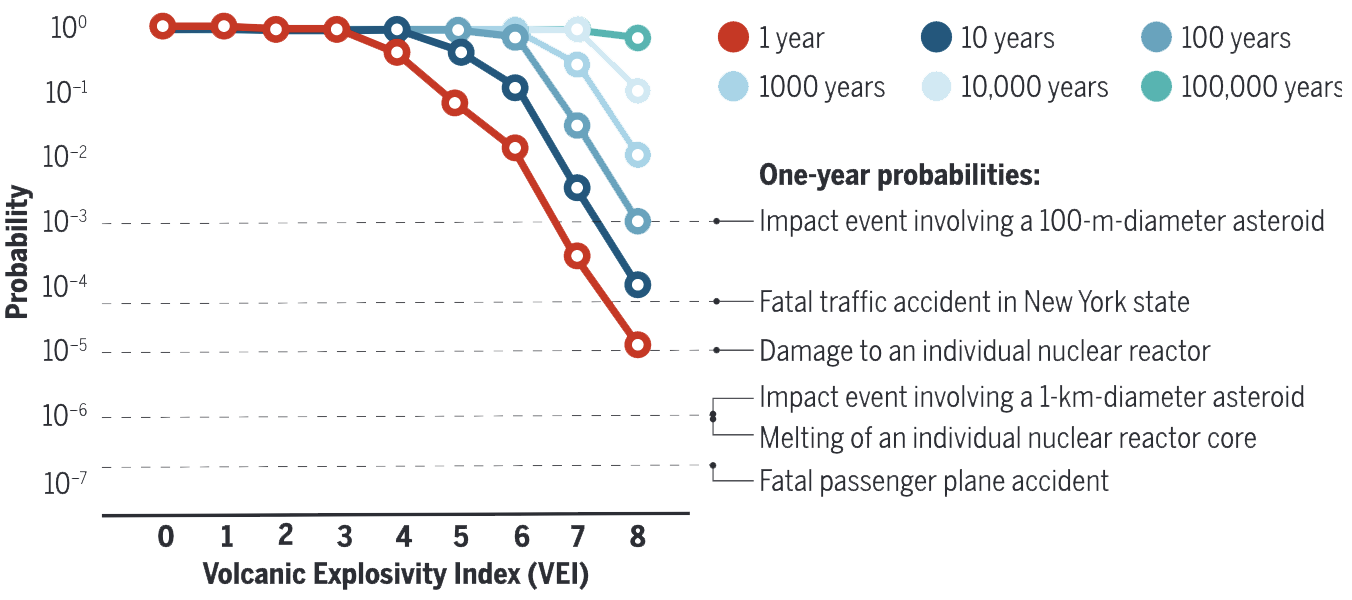
Papale and Marzocchi (2019)

Papale and Marzocchi (2019)

National Academy of Sciences (2017)

National Academy of Sciences (2017)

Exercise

Deposit characterisation

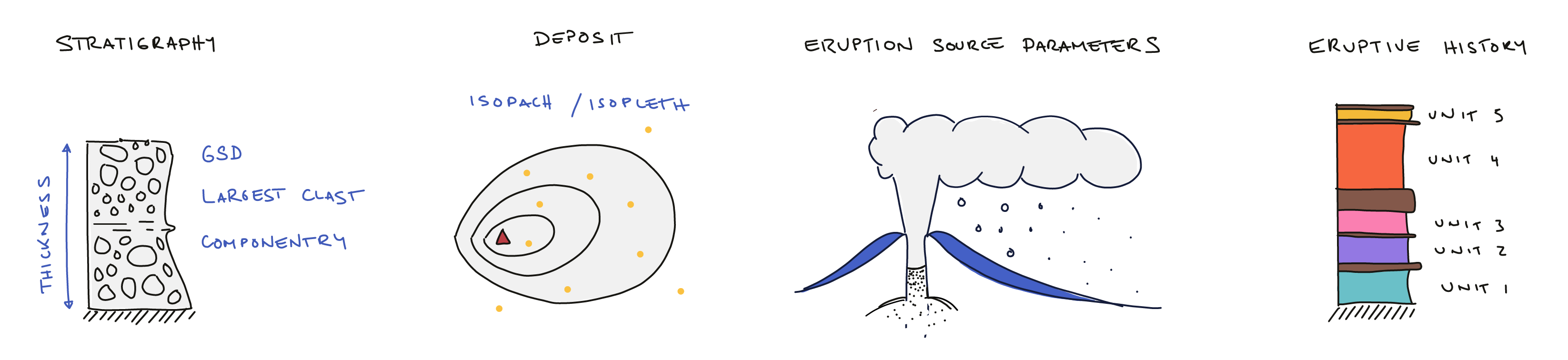
  • Reconstruction of tephra deposits from stratigraphy to estimate eruption source parameters
    • Here: Plume height and erupted volume
  • First step towards eruptive history

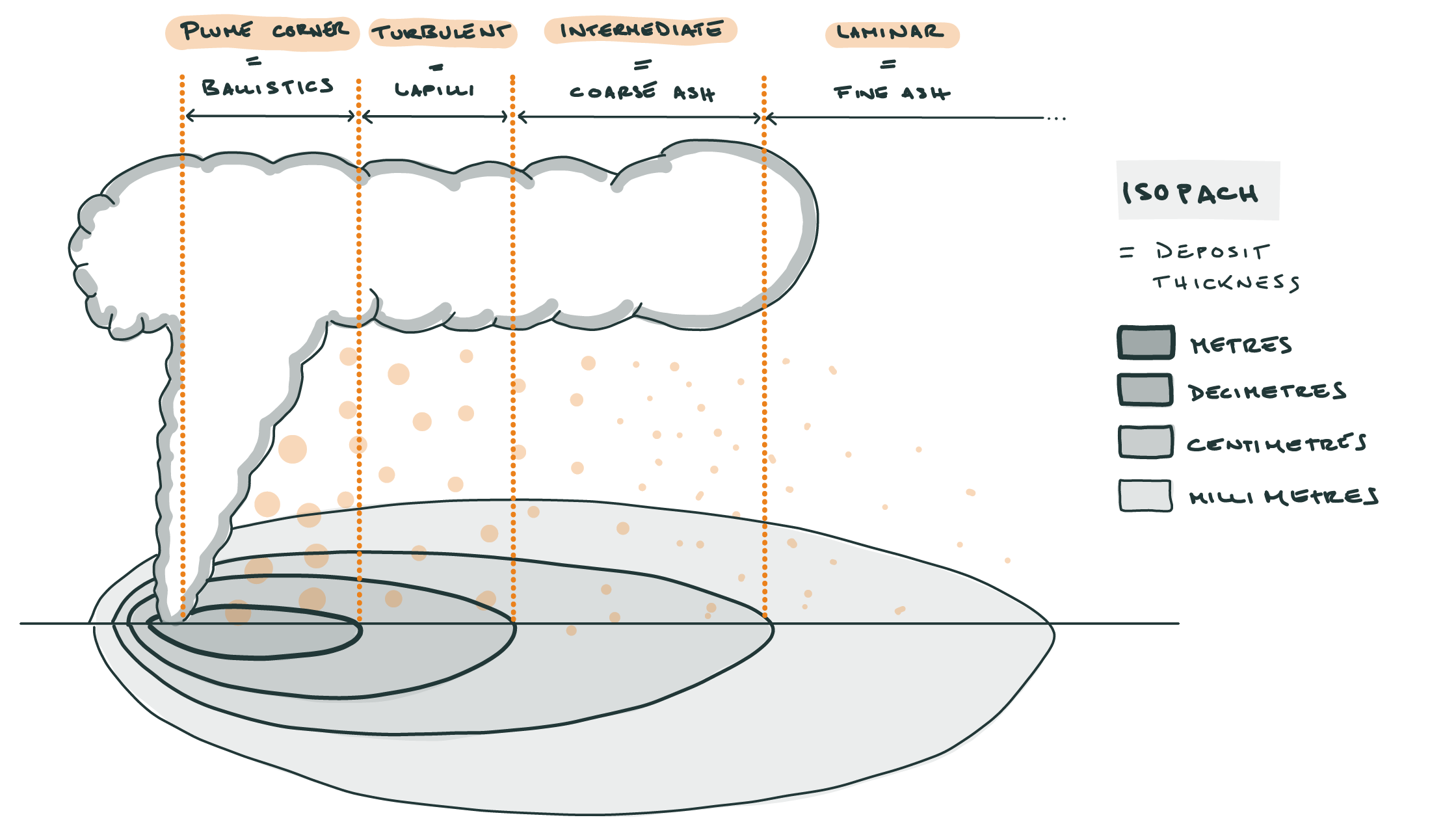
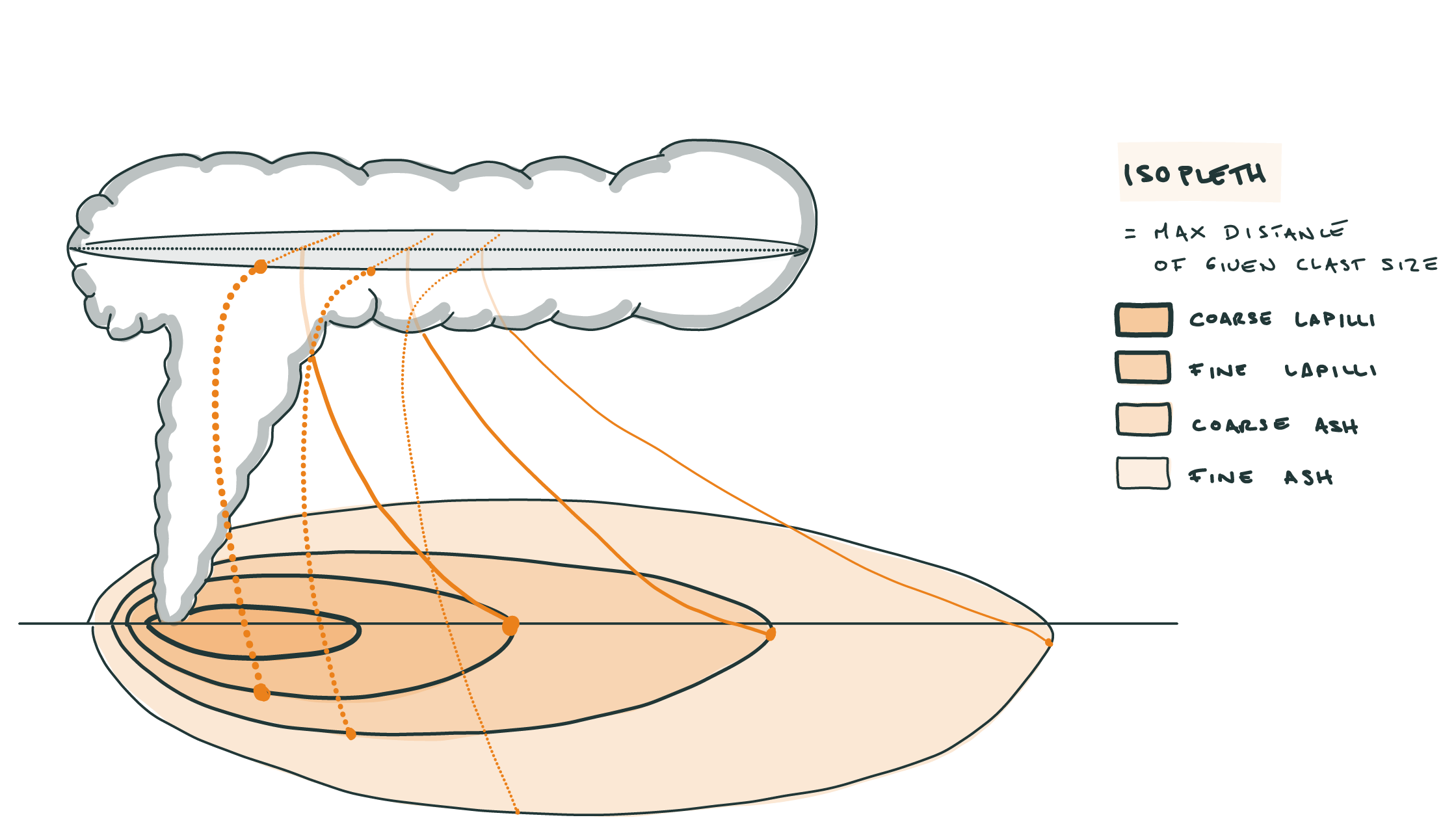
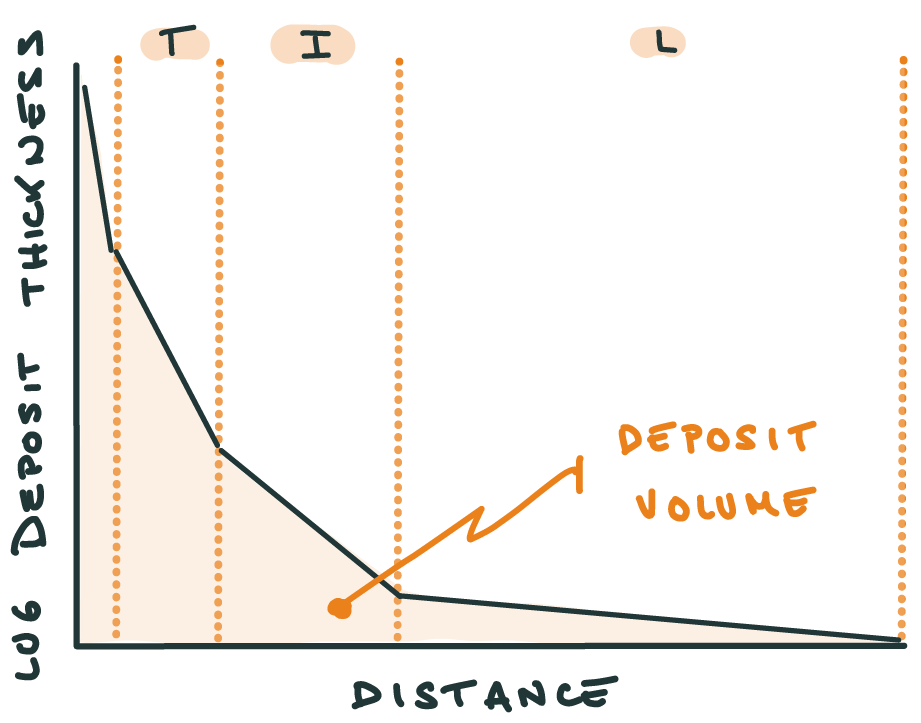
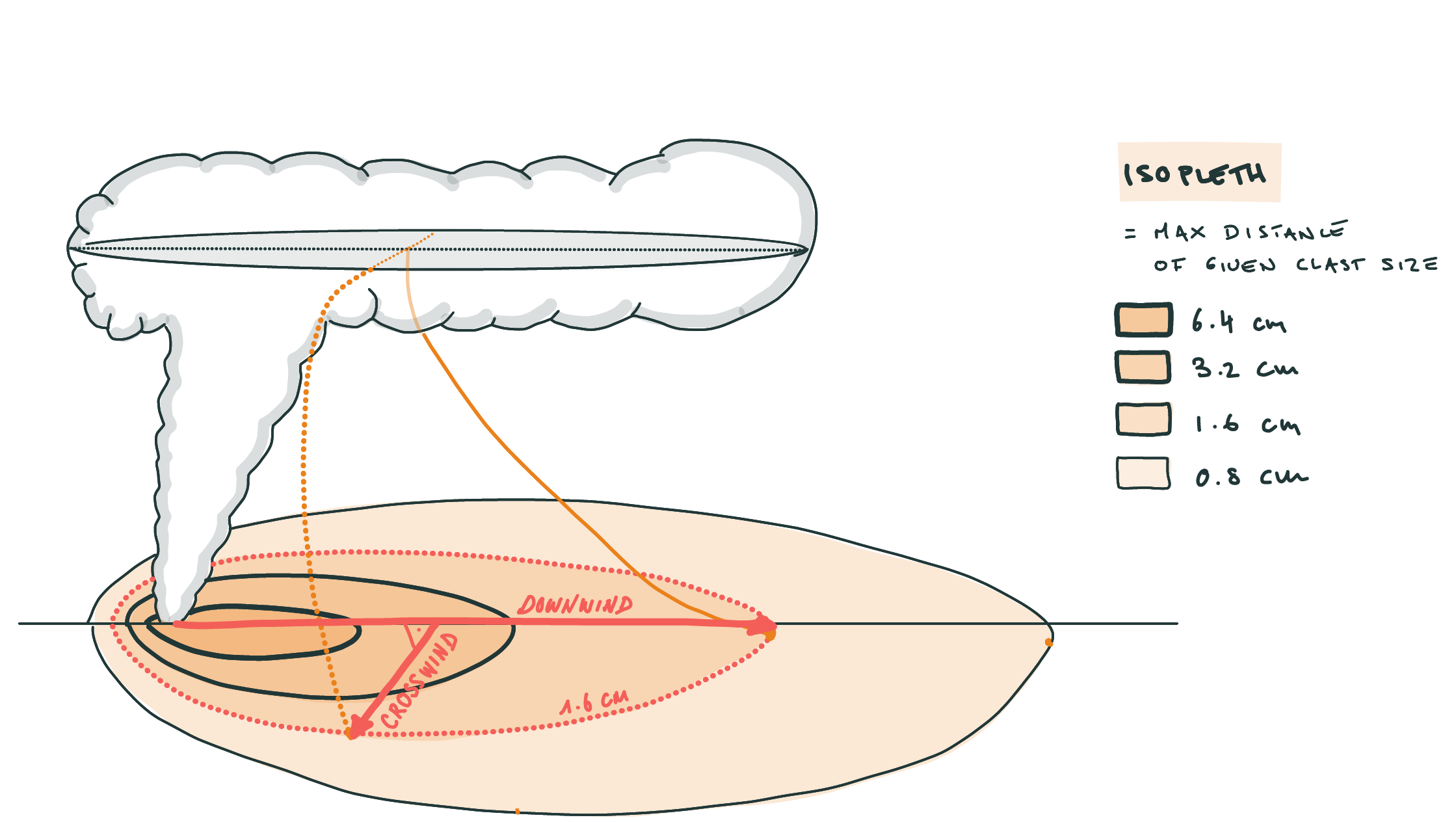
Isopach & isopleth

  • Isopach → contours of equal thickness
  • Compute deposit volume

  • Isopleth → contours of maximum distance of largest clasts (lithics)
  • Compute plume height

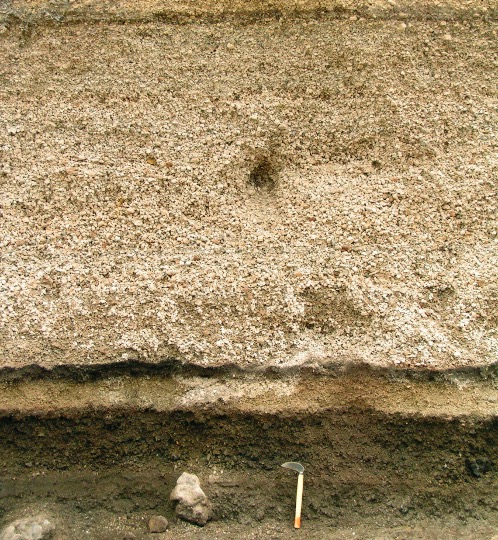
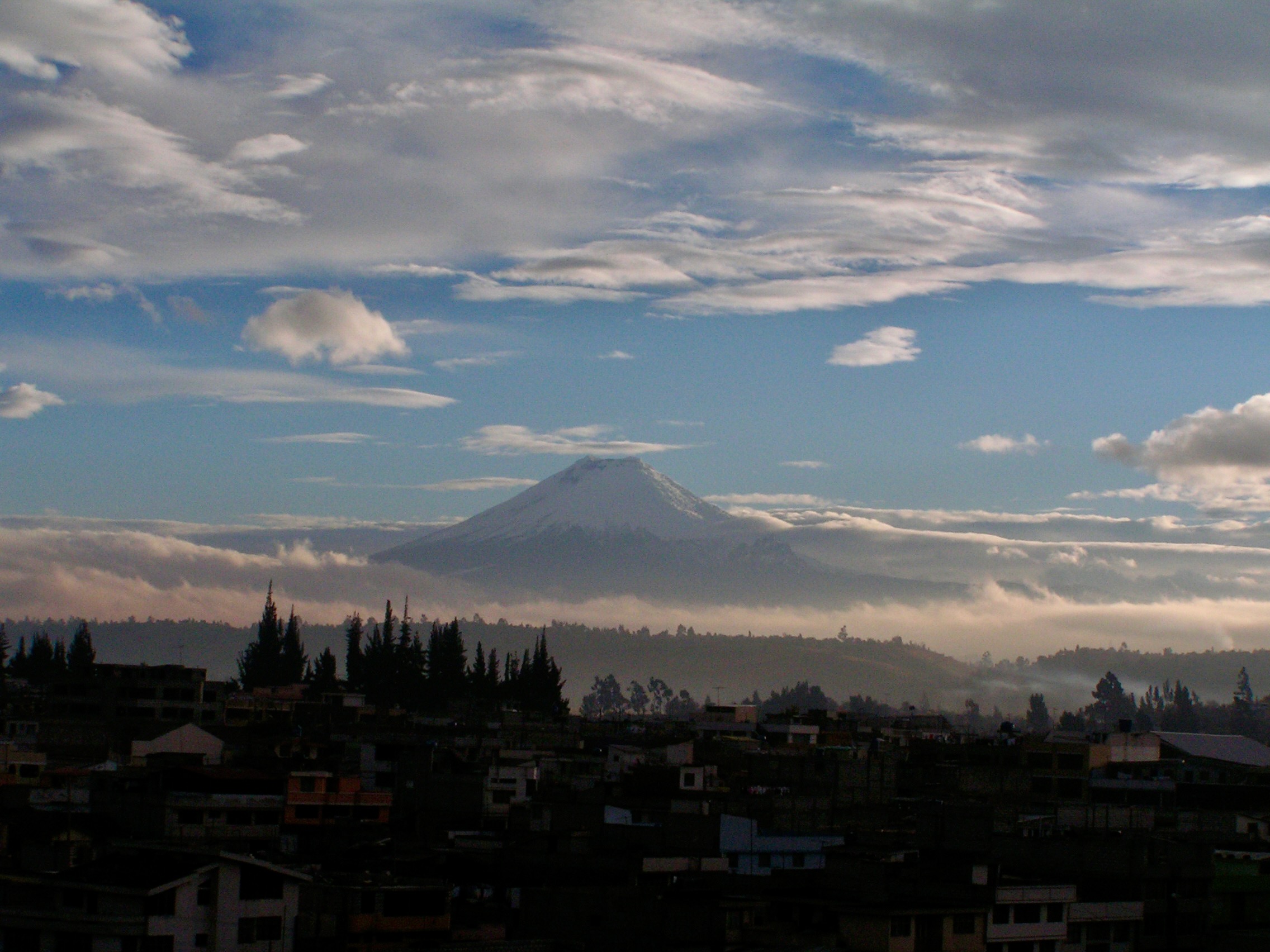
Cotopaxi

  • Layer 5 → black scoriaceous lapilli fallout
  • Age of 1,180±80 years B.P.
  • Whole-rock silica content of 58 wt.%

Objective

  • Estimate erupted volume & plume height

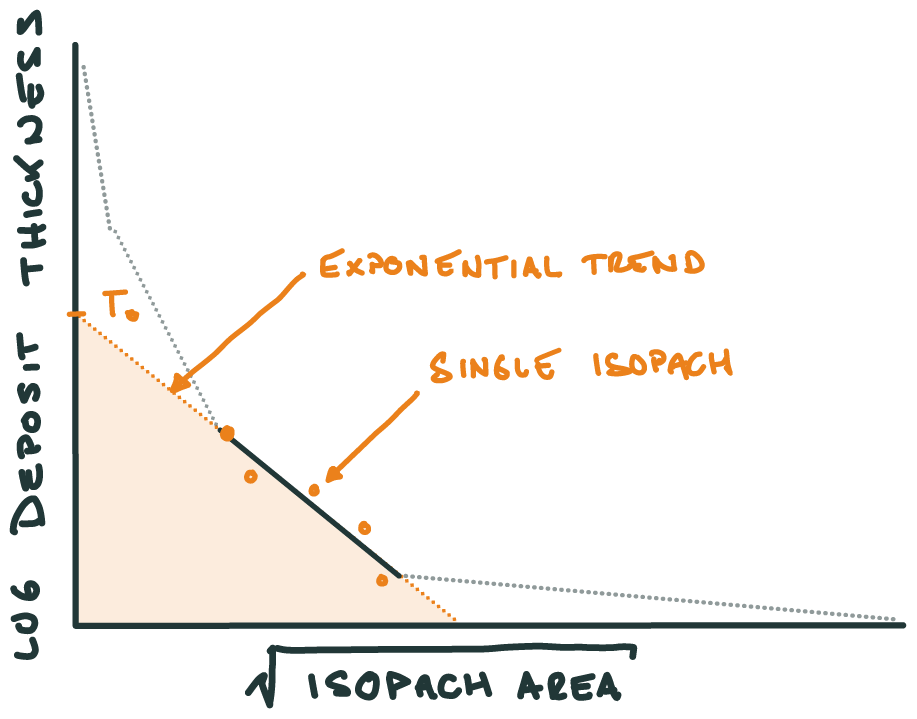
Volume calculation
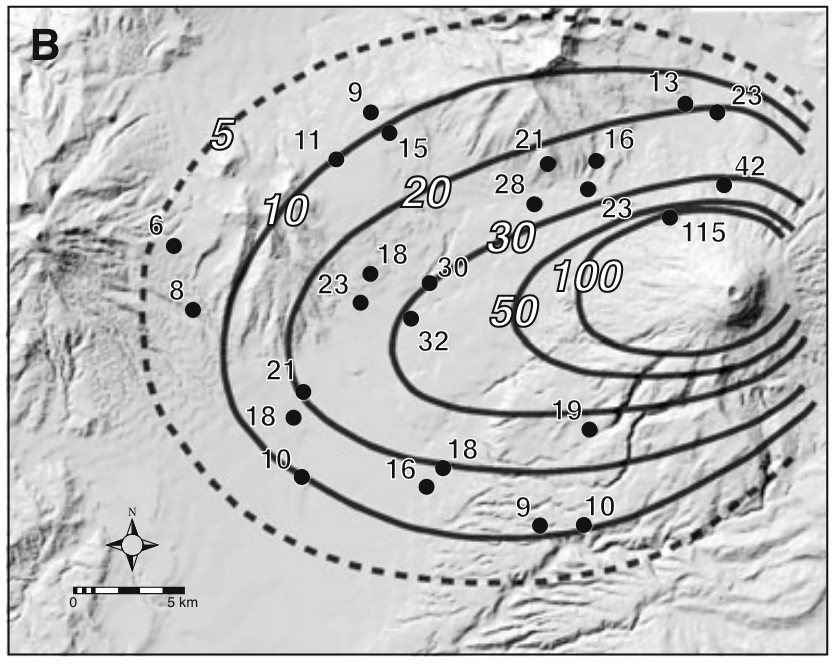
Volume using one exponential segment: \(V = \frac{2T_0}{k}\)

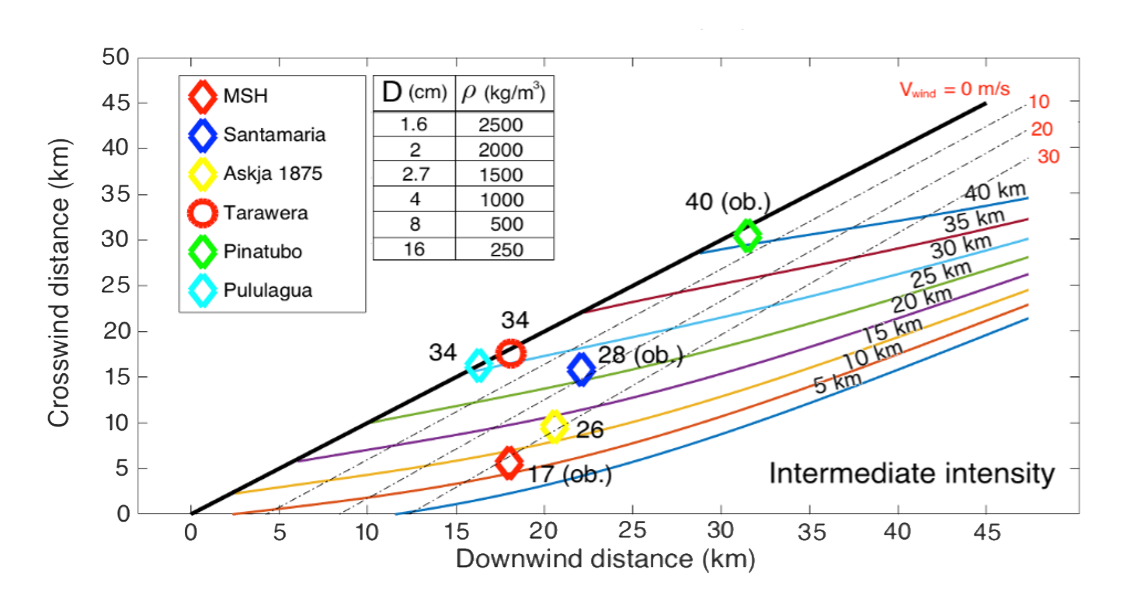
Plume height
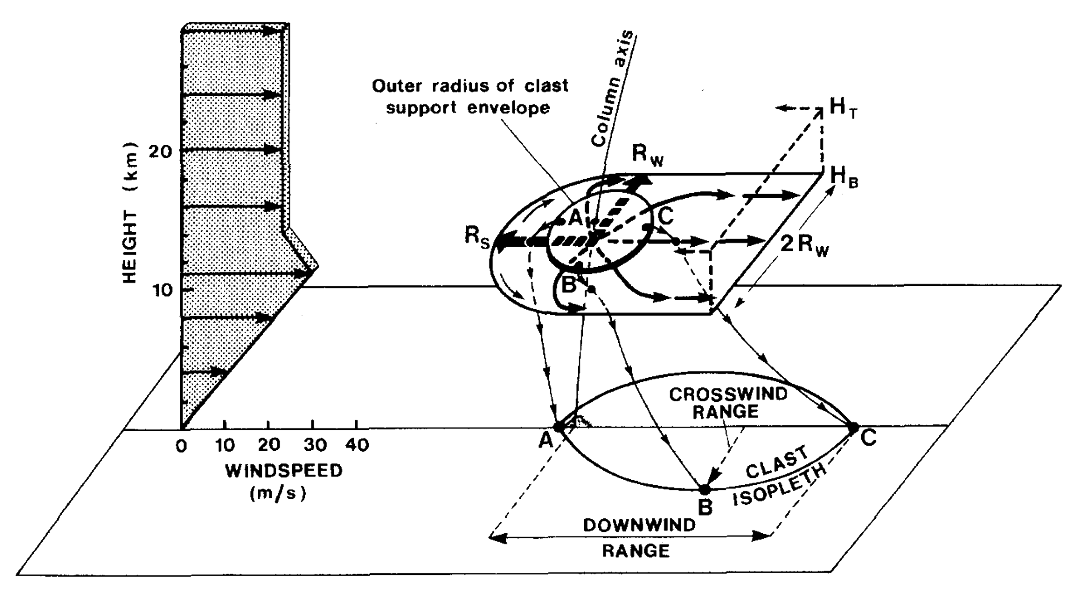
Carey and Sparks (1986)

Carey and Sparks (1986)

Rossi et al. (2019)

Rossi et al. (2019)

  1. Contour isopleth for maximum lithics (\(\rho=2500 kg/m^2\)) for 1.6 and 3.2 cm
  2. Estimate downwind and crosswind ranges
  3. Report on nomograms of Rossi et al. (2019) and estimate plume height and wind speed

Take home messages

Summary

Challenges of “volcano classification”

The surface expression of magma - be it edifice morphology & landform or eruption style - is the result of a cummulation of physical and chemical processes starting as far as the partial melting of the mantle. All possible trajectories of magma generation, transportation and storage induce a diversity of eruptive processes at the surface that is difficult to unify in one single classification scheme.

Morphology of volcanic landforms

Volcanic landforms are the time-integrated expression of all possible eruptive styles that have occured during the eruptive history of the volcano. Polygenetic volcanoes usually concentrate eruptions in a single edifice, building (and destroying) it throughout history (e.g., shield volcanoes, strato/composite volcanoes, calderas). Conversely, monogenetic volcanism creates a new edifice at each eruption, giving rise to minor landforms (e.g., cones).

Summary

Eruption styles

The classification of eruptive styles has evolved from qualitative to field-based and process-based schemes, each with advantages and disadvantages. Qualitative schemes are easy to apply, but are mostly applicable to observed eruptions. Field-based schemes allow comparing deposits recorded in the stratigraphy but typically focus on explosive eruptions. Process-based schemes capture eruptions styles in a dynamic way but rely on analitical data that might impeed their generalisation. There is not a one-to-rule-them-all approach!

Eruption quantification

The role of the volcanologist is mainly to improve our capabilities to forecast the size and frequency of future eruptions, but also to be able to communicate with a broader audience. These aspects require a quantification scheme for eruptions. Historically, the Volcanic Explosivity Index (VEI) is the most used, but magnitude and intensity scale together represent a more complete picture.

References

Bibliography

Bouvet De Maisonneuve C, Forni F, Bachmann O (2021) Magma reservoir evolution during the build up to and recovery from caldera-forming eruptions – A generalizable model? Earth-Science Reviews 218:103684. https://doi.org/10.1016/j.earscirev.2021.103684
Carey S, Sparks R (1986) Quantitative models of the fallout and dispersal of tephra from volcanic eruption columns. Bull Volcanol 48:109–125
Cassidy M, Manga M, Cashman K, Bachmann O (2018) Controls on explosive-effusive volcanic eruption styles. Nature Communications 9:2839. https://doi.org/10.1038/s41467-018-05293-3
Chazot G, Lénat J-F, Maury RC, et al (2017) Volcanologie. De Boeck Supérieur, Louvain-la-Neuve Paris
Karátson D, Thouret J-C (2025) Volcano Geomorphology: Landforms, Processes, and Hazards. Springer Nature Switzerland, Cham
Lockwood JP, Hazlett RW, de la Cruz-Reyna S (2022) Volcanoes: Global perspectives, 2nd edn. Wiley-Blackwell
National Academy of Sciences (2017) Volcanic Eruptions and Their Repose, Unrest, Precursors, and Timing
Newhall CG, Self S (1982) The volcanic explosivity index (VEI)- An estimate of explosive magnitude for historical volcanism. Journal of Geophysical Research 87:1231–1238
Papale P, Marzocchi W (2019) Volcanic threats to global society. Science 363:1275–1276. https://doi.org/10.1126/science.aaw7201
Pyle DM (2015) Sizes of Volcanic Eruptions. In: Sigurdsson H, Houghton B, McNutt S, et al. (eds) The Encyclopedia of Volcanoes. Academic Press, San Diego, pp 257–264
Rossi E, Bonadonna C, Degruyter W (2019) A new strategy for the estimation of plume height from clast dispersal in various atmospheric and eruptive conditions. Journal of Volcanology and Geothermal Research 505:1–12. https://doi.org/10.1016/j.epsl.2018.10.007
Sheridan MF, Wohletz KH (1983) Hydrovolcanism: Basic considerations and review. Journal of Volcanology and Geothermal Research 17:1–29. https://doi.org/10.1016/0377-0273(83)90060-4
Simkin T, Siebert L, Simkin T, Kimberly P (2010) Volcanoes of the World. University of California Press, Tucson, AZ